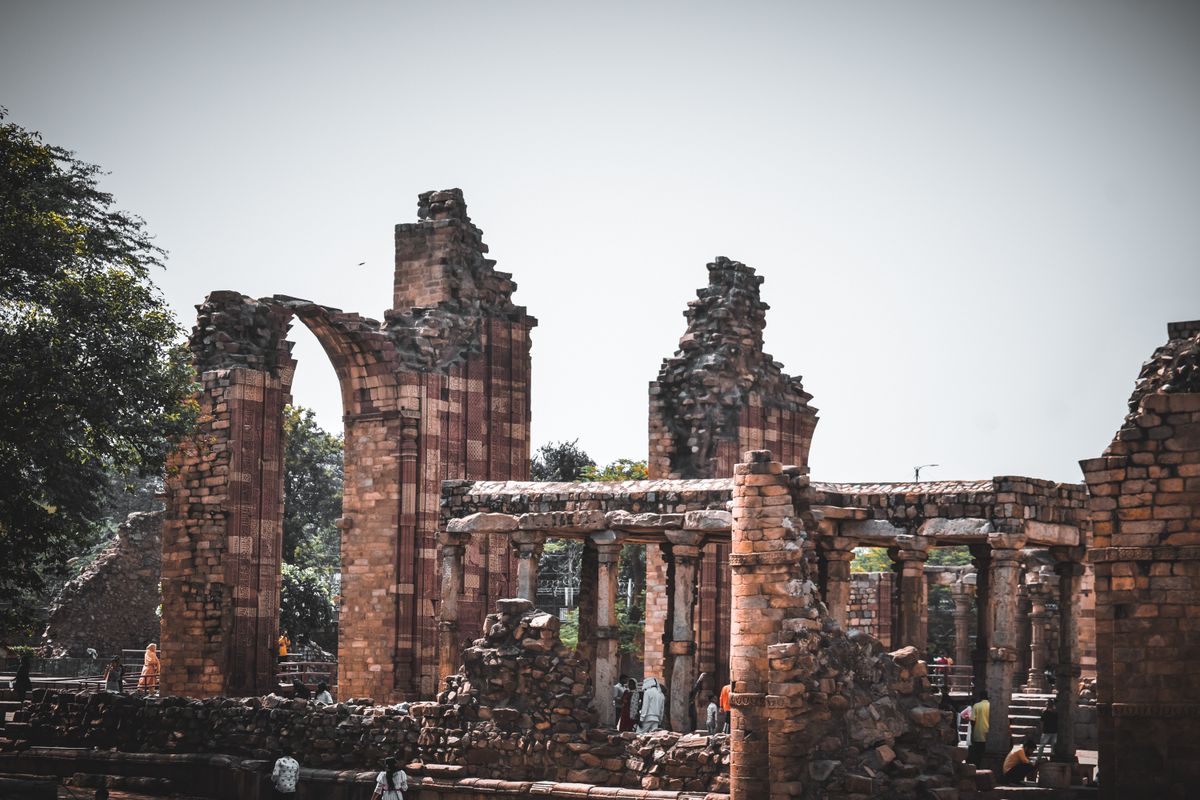
The shape of a Delhi day in May and June
Sunrise in late May is around 05:24 and the air is already at 30°C. By 09:00 it is 38, by 14:30 it peaks between 43 and 47 in the shade, and the hot westerly wind local people call the loo turns the last hours of the afternoon into a hairdryer. The temperature does not fall usefully until after 19:30, and the stone of every monument radiates stored heat well past 21:00. Humidity stays low until the monsoon arrives around the end of June, which is the one mercy: sweat works, and shade is genuinely cooler than sun.
That gives you two usable outdoor windows — roughly 05:45 to 09:30 and 17:30 to 21:00 — and about five hours in the middle that must be spent indoors. Fighting this is the mistake tourists make. Every year visitors collapse at Qutub Minar at 14:00 because it was on the schedule. Build the day around the windows instead and you will see as much as you would in December, eat better, and pay 30 to 40 percent less for your hotel, because May and June are Delhi's cheapest months by a distance.
05:45 to 09:30: the morning window
Set the alarm for 05:15. The best hour of a Delhi summer day is spent in Lodhi Garden, where the joggers and the parakeets have the place before 07:00 and the Sheesh Gumbad throws real shade; or Sunder Nursery, which opens early and whose water channels drop the ambient temperature by a couple of degrees. If you want monuments, Humayun's Tomb from opening is the right choice — the platform is enormous and empty at that hour and you will be finished before the stone starts to burn through thin soles.
The alternative morning is Mehrauli Archaeological Park at 06:30, where the tree cover is dense and the ruins are unstaffed, or the Yamuna ghats near Nigambodh at dawn for the bird life and the ritual bathing. Whichever you choose, carry one litre of water per person minimum, wear a hat with a brim, and put on closed shoes; marble and sandstone at 09:00 will scald bare feet, which matters at any site where you remove footwear. Finish the outdoor block by 09:30 without argument and go and eat breakfast in air conditioning.
09:30 to 11:30: breakfast, then a stepwell
Breakfast somewhere with a working compressor, ₹250 to ₹700 for a proper North Indian plate. Then the smartest transition of the day: a baoli. Agrasen ki Baoli, off Hailey Road behind Connaught Place, is free, 60 metres long, 108 steps deep, and the temperature at the bottom runs several degrees below the street. It takes 30 minutes. Rajon ki Baoli in Mehrauli and Gandhak ki Baoli nearby do the same job further south, both free, both roofless but deeply shaded. Stepwells were built precisely for this problem in precisely this climate.
Follow it with something short and covered: Jantar Mantar's masonry instruments, ten minutes away, take 25 minutes and have partial shade; or the Gurudwara Bangla Sahib complex, where the marble is washed constantly and the covered arcades around the tank are among the coolest public spaces in central Delhi. Both are free or near-free. By 11:30 you should be walking through the door of your last stop before the shutdown, with a full water bottle and no further outdoor commitments until the evening.
11:30 to 16:30: the indoor block, ranked by how cold it is
First choice, the National Museum on Janpath: three floors, properly cooled, the Harappan galleries and the Buddhist relics, and a good two and a half hours of content. Closed Mondays. Second, the National Gallery of Modern Art in Jaipur House by India Gate, quieter, cooler, and strong on Amrita Sher-Gil and the Bengal School. Third, the National Rail Museum in Chanakyapuri, where the indoor gallery is cold but the exhibits you came for are on open track — do it in the morning window instead if trains are the priority.
Fourth and genuinely worth the taxi ride: the Kiran Nadar Museum of Art in Saket, free, contemporary and air conditioned to a level bordering on unkind. Fifth, the Crafts Museum on Bhairon Marg, whose galleries are cooled but whose village courtyard is not. If museums are exhausted, the malls at Saket and Vasant Kunj are legitimate — a two-hour lunch and a cinema is not a failure of imagination in 46°C, it is the correct decision. Better still, go back to the hotel pool at 13:00 and sleep for an hour.
16:30 to 19:30: the second window, and what to drink
By 17:00 the sun is off the vertical and shaded courtyards are usable again. Qutub Minar in the last two hours before sunset is the classic evening move — the red sandstone goes copper and the crowds are thin on weekdays. Purana Qila works the same way, with the added option of a pedal boat on the lake outside. Sunder Nursery and the Garden of Five Senses both stay open into the evening and both are, at this hour, populated entirely by locals, which tells you they are the right call.
Drink deliberately. Aam panna, the raw-mango cooler with cumin and black salt, is the summer drink that actually works, ₹40 to ₹80 at a decent shop. Sweet or salted lassi in a clay kulhar at ₹60 to ₹120. Nimbu pani, but only where they use bottled water and you can see the ice source. And kulfi: the stuffed fruit kulfis from the old kulfi shops in the Sitaram Bazaar lanes of Old Delhi, ₹80 to ₹150, are the single best hot-weather thing this city makes. Skip roadside sugarcane juice, however tempting the machine looks.
After 19:30: the night that Delhi actually lives in
This is when the city comes outside. The Old Delhi food lanes behind Jama Masjid do their real trade from 20:00, with kebabs and nihari at ₹150 to ₹500 a plate. Connaught Place's Inner Circle fills up. Rooftops in Hauz Khas run to midnight. If you want something ticketed, the sound-and-light show at Purana Qila runs on summer evenings, and the musical fountain at Akshardham is timed for after sunset. Almost nothing ASI-managed stays open after dark, so the evening is for eating, markets and lit-from-outside architecture.
One genuinely special option, Thursdays only: qawwali at the Hazrat Nizamuddin dargah from around 18:30, in a courtyard that is warm and packed and worth every degree. Go with covered head and shoulders, leave shoes at the stand for ₹10, and sit at the edge rather than the middle if you want to leave early. Afterwards, eat in the basti lanes at ₹200 to ₹400. It is the one activity in Delhi where the heat becomes part of the experience rather than an obstacle to it.
Heat first aid, and how to choose a summer hotel
The warning signs, in order: stopping sweating, headache, nausea, confusion. At the first one, get indoors, drink an ORS sachet mixed in a litre of water, ₹10 from any chemist, and stop for the day. Delhi hospitals see heatstroke cases through May and June every year and a large share of them are avoidable. Carry two litres per person, wear loose cotton or linen with long sleeves rather than a vest, and reapply sunscreen at midday even if you are indoors, because the walk between taxis is where the sunburn happens.
For the hotel, three things matter more than star rating. A pool, because it becomes the afternoon activity — mid-range South Delhi and Aerocity properties with one run ₹5,000 to ₹9,000 in June, well below their winter rates. Power backup that covers the air conditioning, not just the lights, which is a question worth asking in writing at guesthouses under ₹2,500. And a room that does not face west, since Delhi's afternoon sun on a west wall will defeat an underpowered split unit by 16:00. Rooms in Karol Bagh, Paharganj and Lajpat Nagar drop to ₹800 to ₹2,000 in these months for exactly this reason.
Questions, answered
How hot does Delhi actually get in May and June?
Daytime highs of 42 to 46°C are routine, with 47 to 48 recorded in the worst weeks and night lows staying near 30. The dry heat and the loo wind matter as much as the number; humidity stays low until the monsoon breaks around the end of June, which then trades heat for stickiness.
Is the monsoon a better time to visit than the pre-monsoon heat?
Marginally. From July temperatures drop to 32 to 36°C but humidity climbs, waterlogging closes roads for hours after heavy rain, and the light is grey. Prices stay low in both seasons. If you can only travel in summer, June before the break gives more reliable sightseeing days than August.
Do monuments close during heatwaves?
Archaeological Survey sites keep sunrise-to-sunset hours year round and do not close for heat, though ticket counters can shut early at outlying sites. What changes is the crowd: Qutub Minar and Humayun's Tomb are close to empty between 11:00 and 16:00 in June, which is precisely when you should not be there.
What should I wear?
Loose, light-coloured cotton or linen with long sleeves, a brimmed hat, sunglasses and closed shoes with socks you can slip off at religious sites. Bare arms burn within 20 minutes at midday and stone floors at mosques and gurdwaras reach temperatures that make barefoot walking painful by 10:00.
Doing good is the business: every booking through Stay New Delhi funds one verified tonne of carbon removal — same room, same price, no markup.
Start Your Search