How these seven were ranked
The ranking rewards density: how many genuinely old, genuinely standing structures you pass per kilometre without needing a car between them. Then shade, because Delhi walking is a heat-management problem for eight months of the year. Then traffic — a route where you spend twenty minutes waiting to cross a six-lane road loses points no matter what is on the far side. Metro access matters too, since an auto from the station to the trailhead costs ₹40 to ₹80 and adds friction. Finally, whether the route makes narrative sense: seven cities of Delhi laid end to end rather than a random scatter of domes.
Timing is not optional. From mid-October to mid-March, start at 7am and you will have Mehrauli or Lodhi Garden almost to yourself, with temperatures around 10-16°C. From April, start at 6.30am and finish by 10am; by May and June the afternoon hits 43-45°C and walking is genuinely dangerous. In monsoon, July to September, the ruins look their best — green, wet, dramatic — but the lanes of Shahjahanabad flood ankle-deep within twenty minutes of heavy rain. December and January bring smog that flattens every long view, so save the ridge and the ramparts for February onward.
1. Mehrauli Archaeological Park — the densest square mile in India
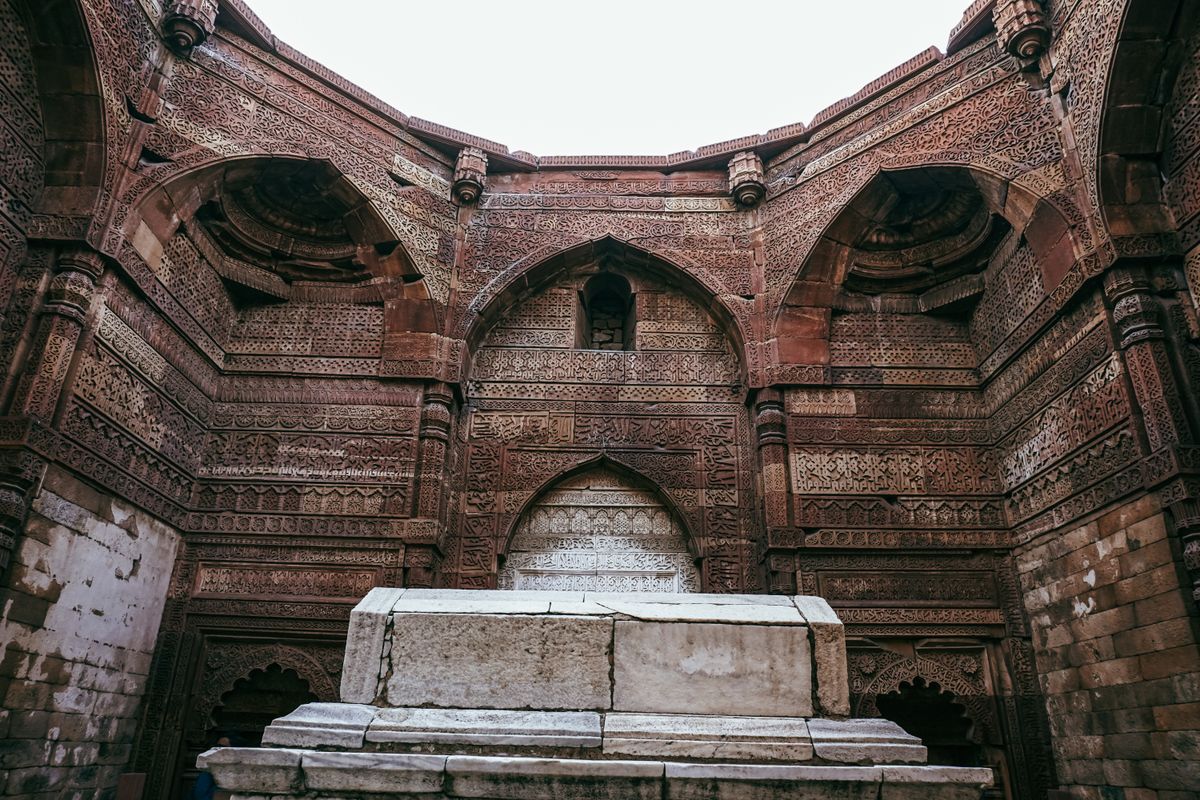
Nothing else in Delhi comes close. In roughly 200 acres behind the Qutub complex you walk past Balban's tomb, the first true arch built in India, then Jamali Kamali's mosque and its jewel-box painted tomb chamber, then Rajon ki Baoli — a four-tiered stepwell you can descend — then Quli Khan's tomb, which the Englishman Thomas Metcalfe converted into a weekend house in the 1840s. The park is free and unfenced in most directions. Two hours covers it at a slow pace, and the tree cover means you can stretch that to three even in April.
Do the park first at 7am, then buy your Qutub Minar ticket — around ₹40 for Indian nationals, ₹600 on a foreign passport — and arrive at the complex by 9am before the tour buses. The nearest metro is Qutub Minar on the Yellow Line, but it sits about 2km from the park gate, so take an e-rickshaw for ₹30-₹50 to Ahinsa Sthal or the Mehrauli bus terminus. Jamali Kamali's inner chamber is often locked; the caretaker will usually open it, and ₹50-₹100 is the accepted courtesy. Finish with a paratha in Mehrauli village.
2. Nizamuddin Basti to Sunder Nursery — the living-and-dead route
Second, and first if you want people rather than only stones. Start at Hazrat Nizamuddin Dargah at 8am while the basti is waking up: Ghalib's tomb, Chausath Khamba's sixty-four marble columns, Atgah Khan's tomb wedged between houses, and the lanes selling rose petals and shirmal bread. Cross under the road to Humayun's Tomb, where the ticket runs around ₹40 and ₹600 respectively, then walk north into Sunder Nursery, a 90-acre heritage park with fifteen restored Mughal monuments scattered through the beds.
The stretch is about 4km with almost no traffic once you are inside the Nizamuddin enclave, and it is the one route where you can eat well mid-walk — the basti's kebab and nihari shops open by mid-morning. Sunder Nursery charges roughly ₹50 on weekdays and more at weekends, and it has clean toilets, a café and lawns you can sit on, which no other route offers. Nizamuddin metro station is on the Pink Line at Sarai Kale Khan; JLN Stadium on the Violet Line is a ₹60 auto ride away. Allow four hours end to end.
3. Shahjahanabad: Fatehpuri Masjid down to Jama Masjid
The most intense walk in the city, and third only because you spend it dodging handcarts. Begin at Fatehpuri Masjid at the western end of Chandni Chowk at 8am, when Khari Baoli's spice warehouses are loading and the air is genuinely peppery. Turn down Naughara Gali for its nine Jain havelis, then Kinari Bazaar for wedding trim, Dariba Kalan for silver, Ballimaran for Ghalib's haveli and the spectacle shops, and end at Jama Masjid's northern gate. Two and a half kilometres, three hours, and roughly four hundred years of continuous occupation.
Get out at Chandni Chowk on the Yellow Line or Lal Qila on the Violet Line. Do not attempt this after 11am on a weekday, and note that most shops shut on Sundays, which makes the lanes walkable but strips out the theatre. Wear closed shoes; the drains are open in places. Jama Masjid's courtyard is free to enter, with a fee of around ₹100 for a camera and a separate charge to climb the southern minaret. Skip the cycle-rickshaw circuits sold near the metro exit at ₹200-₹400 an hour — you see less, not more.
4 and 5. Lutyens' Delhi at dawn, and Lodhi Garden with the Art District
Fourth: the imperial capital, walked between 6.30am and 8.30am when Kartavya Path belongs to joggers. Start at India Gate, walk west along the 3km axis to the Rashtrapati Bhavan gates, detour to the North and South Block ramps for the best sightline in the city, then cut north to Agrasen ki Baoli off Hailey Road — a 60m stepwell dropped between office blocks, free and open from 9am. It is flat, shaded by jamun trees and entirely free. The catch is that it is architecture-as-power rather than ruins, and there is nothing to eat until Connaught Place.
Fifth: Lodhi Garden, 90 acres open from 5am, holding Muhammad Shah's tomb, Bara Gumbad, Sheesh Gumbad with its blue-tile traces, Sikandar Lodi's walled tomb garden and the Athpula bridge. It is a 45-minute loop at strolling pace. Then walk fifteen minutes east into the Lodhi Art District in Lodhi Colony, where about fifty large murals cover the 1940s government housing blocks — the only proper street-art quarter in the country. Combined, it is the easiest good walk in Delhi: free, flat, safe after dark, and served by Jorbagh and Khan Market metro stations.
6 and 7. Company Delhi, and the ridge behind Qutub
Sixth is the British-era route that almost nobody walks: Kashmere Gate metro to the gate itself, still pockmarked from 1857, then St James' Church of 1836, Nicholson Cemetery, the Old Secretariat, and up into Civil Lines for Flagstaff Tower and the Mutiny Memorial on the northern Ridge. Around 5km, mostly on pavement, with long empty stretches — go in a pair, and bring water because there are few shops. It suits readers of 1857 history and nobody else; the buildings are locked more often than open, and the Ridge path is unlit.
Seventh is Sanjay Van, 780 acres of thorn forest on the southern Ridge between Vasant Kunj and Mehrauli, threaded with the rubble walls of Qila Rai Pithora, Delhi's oldest city. Enter from the Mehrauli or Vasant Kunj gates at 7am, follow the marked trails past the dargah and the small lakes, and expect peacocks, nilgai and about 90 bird species in winter. It is a forest walk with archaeology in it rather than the other way round, which is why it sits last — but on a February morning with mist in the keekar it beats every ticketed monument in the city.
Guided or solo, and what a walk should cost
Delhi has a real walking-tour industry, and for Shahjahanabad and Nizamuddin it is worth paying for. Established operators run scheduled public walks in the ₹800-₹1,800 per person range for two to three hours, with private walks for two people typically ₹3,000-₹6,000. INTACH's Delhi chapter and the community-run Nizamuddin basti walks are the best value; the food-plus-history hybrids in Old Delhi at ₹2,000-₹2,500 include five or six tastings and are the right choice if you only have one morning. Book two or three days ahead in season, because winter weekend slots sell out.
Do Mehrauli, Lodhi Garden and Lutyens' Delhi on your own — signage and Google Maps are sufficient, and a guide adds little in an open park. Skip the hop-on-hop-off bus tours as a substitute for walking; they stop at eight monuments and give you twenty minutes at each, which is exactly the wrong ratio. Also skip any operator promising a Yamuna riverfront walk — the riverbank is not a walkable heritage route, whatever the listing photos suggest. Carry two litres of water per person, ₹500 in small notes for entry fees and shoe minding, and a scarf for the dargah.
Questions, answered
Which single walk should I do if I only have one morning?
Nizamuddin Basti into Humayun's Tomb and Sunder Nursery. It gives you a working shrine quarter, a World Heritage tomb and a restored Mughal garden in one 4km line, with food and toilets on the route. Start at 8am and you will be done by noon.
Is it safe to walk alone in Old Delhi as a woman?
Yes in daylight, and the lanes are busy rather than isolated. The realistic issues are crowds, staring and handcart traffic, not crime. Dress covered, keep your bag in front in Kinari Bazaar, avoid the stretch after dark when shutters come down, and use the metro rather than a late auto.
What do the monument tickets cost on these routes?
Most ASI sites charge around ₹40 for Indian nationals and ₹600 for foreign passports at World Heritage sites like Qutub and Humayun's Tomb, and roughly ₹25 and ₹300 at smaller ones. Mehrauli Archaeological Park, Lodhi Garden and Sanjay Van are free. Carry ₹500 in cash for stepwell caretakers and shoe minding.
When is the walking season genuinely over?
By the first week of April, morning temperatures cross 28°C and midday hits 40°C. From then until late June, walk only between 6am and 9am. July to September is humid but tolerable in short bursts, and mid-October to mid-March is the proper season, with January mornings around 8°C and heavy smog.
Doing good is the business: every booking through Stay New Delhi funds one verified tonne of carbon removal — same room, same price, no markup.
Start Your Search