Delhi in January: fog, flight delays and how to plan around them
Between 20 December and 20 January, Delhi loses visibility to under 50 metres on roughly one morning in three — here is how to build an itinerary that survives it, and why the first three weeks of January are the cheapest peak-season rooms you will find.
The fog window, precisely
Delhi's fog is radiation fog: clear still nights, ground cooling fast, moisture condensing at head height. It forms between 2 and 6 a.m., peaks between 6 and 9 a.m., and usually lifts between 10 a.m. and noon, though on the worst days of a cold wave it never fully clears and the sun stays a pale disc until sunset at 5.40 p.m. The core window is 20 December to 20 January, with a secondary tail into early February. Expect eight to twelve dense-fog mornings across that month, and two or three where visibility drops below 50 metres.
This matters more than the temperature does. Delhi's January minimums of 4 to 8°C are not cold by European standards, but the combination of damp, no central heating in most buildings, and a sun that does not appear before eleven makes the mornings feel far colder than the number. Locals dress for it: layers, a shawl, and breakfast delayed. Visitors who booked a 7 a.m. monument slot in January are the ones standing outside a locked gate in the grey wondering where the city went.
Flights: what actually happens at Terminal 3
Indira Gandhi International has CAT III B capable runways and a large share of pilots and aircraft certified for low-visibility operations, which means Delhi keeps landing traffic when most Indian airports would close. What it does not do is keep to schedule. On a dense-fog morning, departures between 6 and 11 a.m. run two to five hours late, aircraft and crews go out of position, and the delay cascades through the whole day. Cancellations happen but are the minority; the norm is a long, information-poor wait in a very full terminal.
Three rules fix most of this. Book departures after 1 p.m. in January, when the recovery has begun and slots are moving. Never build a same-day self-transfer connection through Delhi in this window — put a night in between, ideally in Aerocity, ten minutes from the terminals. And if you are flying out to a smaller airport such as Dehradun, Jaisalmer, Gorakhpur or Bhuj, understand that those fields lack CAT III equipment, so your delay becomes their cancellation. Keep one flexible day at the end of a January trip.
Trains and roads are worse, not better
The instinct to take the train instead is usually wrong in January. North India's premium services — the Rajdhani, Shatabdi and Vande Bharat sets running to Lucknow, Varanasi, Patna, Kolkata and Amritsar — routinely run four to ten hours behind in the fog fortnight, and the delay is announced in increments so you cannot plan around it. Short daylight runs survive better: the Gatimaan and Vande Bharat services to Agra, both around 100 to 110 minutes, mostly hold their timings because they depart after the fog has lifted.
Roads deserve real caution. The Yamuna Expressway to Agra and the Delhi-Jaipur stretch of NH-48 produce multi-vehicle pile-ups every January, always at dawn, always because someone kept doing 100 km/h into a wall of white. If you are self-driving or hiring a car for a day trip, set departure at 8.30 a.m., not 5.30 a.m., accept that you will reach Agra at eleven, and use the afternoon Taj entry. That single change removes the only genuinely dangerous decision in a Delhi winter itinerary.
Heating, hot water and what to ask before you book
Indian buildings are designed to shed heat, not hold it. In January that means marble floors at 12°C, single-glazed windows and, in budget rooms, no heating at all. Paharganj and Karol Bagh rooms under ₹1,500 often supply a single thin quilt and a bathroom geyser that has to be switched on twenty minutes ahead. Ask directly whether the room has a working heater — many three-stars have blower heaters available on request at no charge, some rent them at ₹200 to ₹400 a night, and a few refuse on load grounds.
From about ₹4,000 upwards, reverse-cycle air conditioning does the job properly, and anything at four-star level or above is genuinely warm. Two other checks: hot water pressure at 7 a.m., when everyone in the building wants a shower, and whether the room faces an internal shaft, because a January room with no direct sun is 4 or 5 degrees colder all day. If you feel the cold, spend the extra ₹1,200 a night to move from a Paharganj guesthouse to a Karol Bagh three-star. It is the best-value upgrade in a Delhi winter.
The rate valley nobody books
Between 2 and 20 January, Delhi hotel rates hit their lowest point of the entire peak season. New Year demand has gone, the wedding calendar is still inside Kharmas and does not restart until Makar Sankranti on 14 January, corporate travel restarts slowly, and international leisure arrivals dip. Karol Bagh and Lajpat Nagar three-stars that wanted ₹4,500 in November go for ₹2,600 to ₹3,400. Aerocity four- and five-stars sit at ₹6,500 to ₹9,500. Greater Kailash and Defence Colony boutique guesthouses land at ₹3,000 to ₹4,500 with breakfast.
Two spikes interrupt it. Republic Day, 26 January, falls on a Monday in 2026, creating a three-day weekend that fills central Delhi and drives Lutyens-area rates back over ₹22,000; and the wedding restart from mid-January reloads the banquet-heavy hotels in Rajouri Garden, Punjabi Bagh and Chattarpur. Book 2 to 20 January and you get peak-season weather at shoulder-season prices, with fog as the only tax. That trade is worth taking if your itinerary has slack in it.
What January uniquely gives you
Winter is when Delhi eats best. Daulat ki chaat, the saffron-flecked milk foam sold from brass trays in the lanes off Chandni Chowk, exists only between roughly November and February and disappears entirely by March. Nihari at dawn around Jama Masjid, gajar ka halwa by the kilo in Karol Bagh sweet shops, sarson ka saag with makki roti in Punjabi dhabas, and the gud and til brittle that appears everywhere before Makar Sankranti — all of it is seasonal and none of it is available in June.
The calendar is dense too. The Republic Day parade on Kartavya Path on the 26th, with full dress rehearsal on the 23rd, and Beating Retreat at Vijay Chowk on the 29th. Lohri bonfires on 13 January in Punjabi neighbourhoods such as Rajouri Garden and Punjabi Bagh. Amrit Udyan, the Rashtrapati Bhavan gardens, opens to the public with free online booking from late January into March. The India Art Fair takes over the NSIC Grounds in Okhla in early February, tickets from around ₹800. None of these run in the hot months.
How to structure a January day
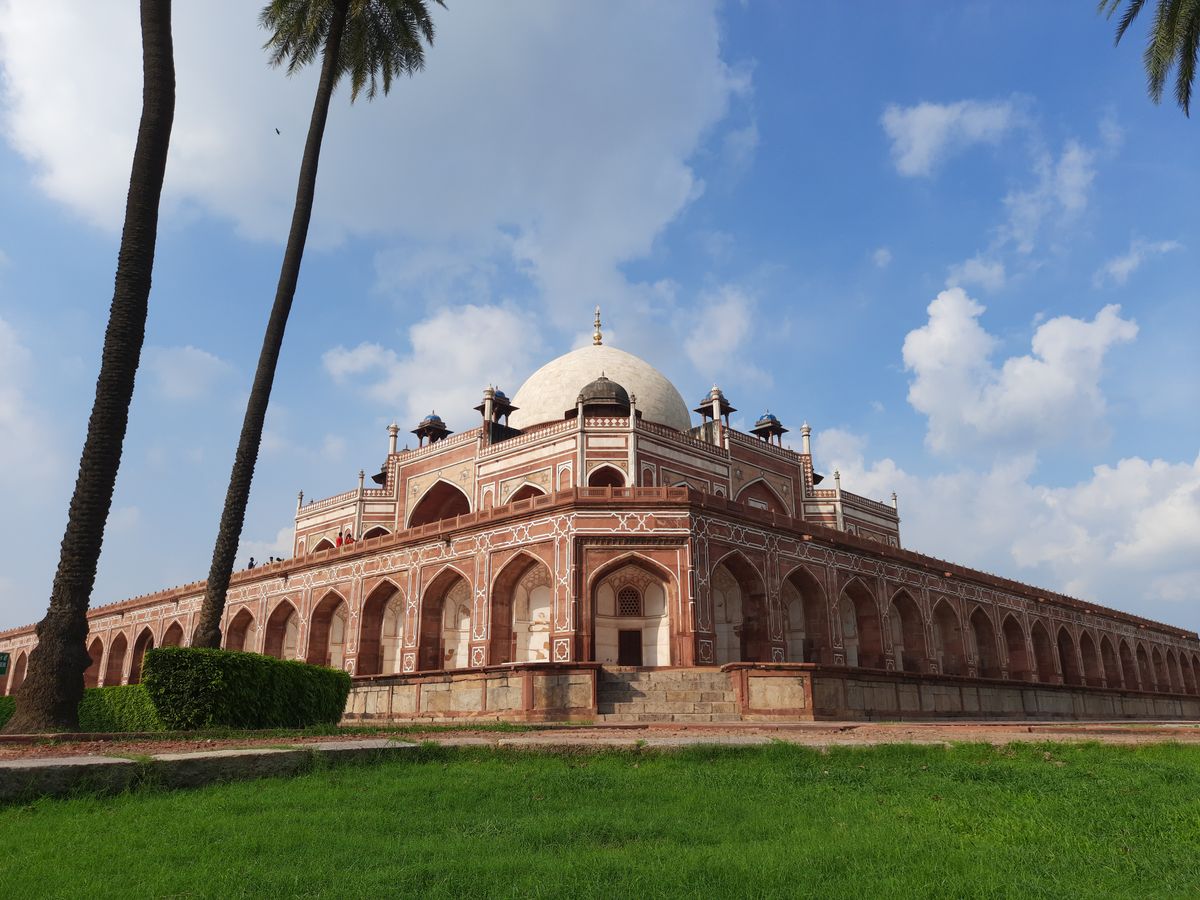
Start late. Nothing outdoors is worth doing before 10.30 a.m. in this month, and the fog usually delivers a beautiful, low, golden light between eleven and one that flatters Humayun's Tomb, Lodhi Garden and the Mehrauli Archaeological Park. Put museums, coffee, markets or a long breakfast in the 8 to 10.30 a.m. slot instead. Then run outdoors from eleven to sunset. Sunset is 5.40 p.m. in mid-January and the temperature drops five degrees within twenty minutes of it, so carry the extra layer you did not think you would need.
Evenings need a plan because they are cold and the city closes earlier than you expect. Rooftop bars in Hauz Khas and Connaught Place either shut or move indoors, and outdoor courtyard restaurants in Mehrauli deploy gas heaters that work well down to about 8°C. Book dinner rather than wandering. And if you have a dawn departure during the fog window, factor a 45-minute crawl to the airport instead of the usual 25 from Aerocity — the Airport Express Metro from New Delhi station, around ₹60 and immune to fog, is the reliable move.
Questions, answered
Should I buy travel insurance specifically for January fog delays?
Buy a policy that covers missed onward connections and unused accommodation rather than one that only pays for cancellation. Fog delays are the single most likely disruption to a north India winter itinerary, and the practical cost is one wasted hotel night plus a rebooked domestic sector. Keep boarding passes and airline delay messages for the claim.
How cold does Delhi actually get in January?
Daytime highs run 18 to 22°C and feel pleasant in sun. Nights and early mornings drop to 4 to 8°C, and a cold wave can push the minimum to 2 or 3°C for a few days. The problem is unheated interiors rather than the outdoor number, so pack layers you can wear indoors.
Is Republic Day week a bad time to be in central Delhi?
For traffic, yes. Kartavya Path, India Gate and the Vijay Chowk approaches close for rehearsals from around 17 January onwards, several Metro station exits near Central Secretariat and Udyog Bhawan shut on the 23rd and 26th, and drones are banned citywide. Stay south of the Ring Road, use the Metro and avoid booking cars into Lutyens.
Doing good is the business: every booking through Stay New Delhi funds one verified tonne of carbon removal — same room, same price, no markup.
Start Your Search