Delhi in the monsoon: what floods, what it costs, what still works
Around 700 mm of rain falls between late June and late September, most of it in bursts of two hours or less — which is why the season knocks 30 to 40 per cent off hotel rates while closing almost nothing you actually came to see.
When the rain arrives and how much of it there is
The monsoon reaches Delhi in the last days of June, usually between the 26th and the 30th, and withdraws in the last week of September. Across those three months the city collects roughly 650 to 800 mm, with July and August carrying about 200 to 240 mm each. The rain does not fall continuously. A typical July week gives you three or four rain events lasting between forty minutes and three hours, often in the late afternoon or overnight, separated by long humid, bright, grey-white stretches where nothing falls at all.
What changes is the feel of the city. Temperatures drop from May's 42°C to daytime highs of 33 to 35°C with humidity between 70 and 90 per cent, which is sweatier but survivable — you can walk at noon in August in a way that is genuinely dangerous in May. Everything green explodes: the Ridge, Lodhi Garden, Sunder Nursery and the Mehrauli park go from dust to jungle in ten days. The air is the cleanest of the year, with readings in the 60 to 110 band instead of November's 400.
The flood map: where the water actually collects
Delhi's waterlogging is predictable and geographically fixed. The underpasses are the problem: Minto Road near New Delhi railway station, Zakhira, Azad Market, Pul Prahladpur on the south edge, Moolchand on the Ring Road, and the Dhaula Kuan approaches. Add the ITO junction, Ring Road near Sarai Kale Khan, the Rohtak Road corridor and the NH-48 service lanes at Mahipalpur, which is exactly the road most airport hotels sit on. After a 60 mm hour, several of these hold knee-deep water for two to four hours and traffic goes nowhere.
Yamuna flooding is a separate and rarer event. The danger mark at the Old Railway Bridge is 205.33 metres; in July 2023 the river hit 208.66 metres and put water into Civil Lines, the Kashmere Gate bus terminal approaches, Yamuna Bazar and stretches of the Ring Road near Rajghat. That is a once-in-a-decade scale, driven by upstream barrage releases rather than Delhi rain. If it happens, the practical effect on a visitor is closed roads in north-east Delhi and Mayur Vihar, not a citywide shutdown.
Getting around when the roads give up
The Metro is the whole answer. Delhi Metro's elevated and underground sections run through every storm, and the Yellow, Blue, Magenta and Violet lines together reach Old Delhi, Connaught Place, Hauz Khas, Saket, Qutub Minar, Nehru Place and both Noida and Gurugram. Fares top out around ₹60, and the Airport Express gets you from New Delhi station to Terminal 3 in about twenty minutes for a similar figure. In monsoon, a Metro-first itinerary is not a budget choice, it is the fast choice.
Above ground, expect app cabs to cancel during heavy rain and surge to two or three times normal, and autorickshaws to refuse waterlogged routes outright. Budget 90 minutes from south Delhi to the airport instead of 45 on a wet evening. If you are catching a flight in July or August, leave absurdly early or take the Airport Express. Avoid hiring a self-drive car in this season; the flooded-underpass judgement call is one you will make wrong once, and once is enough.
The rates: joint cheapest season of the year
July to September is Delhi's low season alongside May and June, and hotels behave accordingly. Aerocity four- and five-stars that hold ₹12,000 in November sell at ₹6,000 to ₹8,500, often with breakfast and airport transfers folded in. Business hotels in Nehru Place, Saket and the Gurugram corridor drop to ₹3,200 to ₹5,000 and effectively give away weekends. Greater Kailash and Defence Colony guesthouses run ₹2,800 to ₹4,200, Karol Bagh three-stars ₹2,200 to ₹3,200, and Paharganj doubles ₹900 to ₹1,600.
Two things to negotiate. First, ask for the pool: many mid-range hotels keep them open through the monsoon and swimming in warm rain is one of the season's genuine pleasures. Second, ask about the higher floors — during monsoon, upper rooms with sealed windows avoid the damp and mildew smell that settles into ground-floor rooms in older buildings. If a room smells musty on check-in, ask to move; in August there is always inventory, and that is the whole argument for travelling now.
What is better in the rain than in the dry
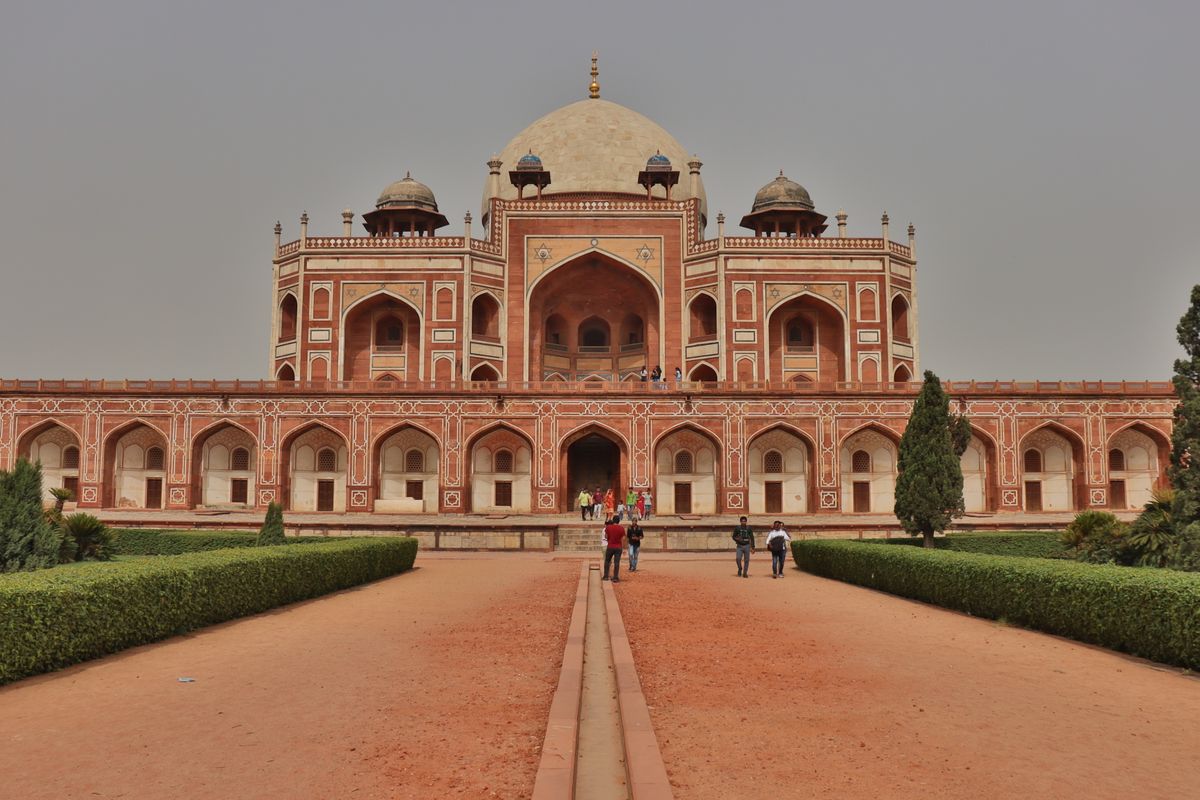
Delhi's ruins were built for this weather. Purana Qila's lake fills, the moat around Tughlaqabad holds water, and the stepwell at Agrasen ki Baoli near Connaught Place stops being a dry pit. Humayun's Tomb, Lodhi Garden and Sunder Nursery, where entry runs about ₹50, are at their absolute best in late August: soaked red sandstone, deep green lawns, and almost nobody there. Hauz Khas reservoir actually holds water again, which transforms the ruins above it. The Mehrauli Archaeological Park becomes overgrown and atmospheric rather than scrubby.
The crowd collapse is the underrated part. Qutub Minar, Red Fort and Humayun's Tomb in mid-August operate at a fraction of December's density, so you photograph them without queues and without a hundred people in frame. Monument tickets are unchanged year-round, around ₹600 for foreign passports at the major ASI sites and small change for Indian nationals. Carry a compact umbrella rather than a rain jacket — at 85 per cent humidity a waterproof shell turns you into a sauna within ten minutes.
Mangoes, kites and Janmashtami
The monsoon is Delhi's best eating window after winter. Mango season peaks through July: Dussehri and Langda by the crate in Azadpur and every neighbourhood market, and the Delhi Mango Festival at Dilli Haat Janakpuri in early July with dozens of varieties to taste for the price of the ₹30 entry. Street food shifts to pakoras and bhutta — charcoal-roasted corn with lime and masala, ₹30 to ₹50 from carts that appear on every corner the day the rain starts. Ghevar, the honeycomb disc soaked in syrup, sells for Teej in July and August only.
The festival calendar is real too. Independence Day on 15 August, a Saturday in 2026, seals off the Red Fort and much of Old Delhi from dawn, with Metro station exits closed at Lal Qila and Chandni Chowk and a citywide ban on kites and balloons near the flight path — plan that day away from the walled city. Janmashtami in late August or early September fills the temples at Mathura and Vrindavan, a three-hour drive, with an intensity that is worth seeing once but not with luggage.
Mosquitoes, damp and who should skip it
Dengue is the real health consideration, and its Delhi peak is September and October rather than July. Use repellent at dusk, prefer rooms with air conditioning and mesh, and be aware that the Aedes mosquito bites during the day. Chikungunya and, less often, malaria circulate as well. Nothing about this should stop a trip: hospital care in south Delhi and Gurugram is excellent and most visitors never notice. Pack repellent from home if you are fussy about brands, though every chemist stocks coils, plug-ins and creams for under ₹150.
Skip the monsoon if your trip is short and tightly scheduled, particularly if it hinges on a same-day Agra return or a dawn flight to Leh. Skip it if humidity flattens you. Take it if you want Delhi at half price with clean air, if you are a photographer, or if you are the kind of traveller who reads a two-hour thunderstorm as an event rather than a ruined afternoon. Late August into the first ten days of September is the sweet spot: green, cheap, and the rain already easing.
Questions, answered
Does it rain all day in the Delhi monsoon?
No. Delhi averages ten to twelve rain days a month in July and August, and most events run under three hours, often overnight or in the late afternoon. Between them the sky is bright grey and humid. You can plan a full sightseeing day and lose perhaps one slot in three to a downpour.
Will a monsoon day trip to Agra be ruined?
Rarely. The Taj Mahal is spectacular against monsoon cloud, the reflecting pools work, and August crowds are the thinnest of the year. Take the morning Vande Bharat or Gatimaan, around 100 minutes each way, rather than driving the Yamuna Expressway, which is where the rain genuinely costs you time and safety margin.
Are hotel pools open during the monsoon?
Most are, and they are quiet. Rooftop pools in Aerocity, Saket and Gurugram close only during electrical storms. Day passes at four- and five-star hotels run ₹1,500 to ₹3,000, often redeemable against food and drink, which is a cheap way to spend a wet afternoon if your own hotel has no pool.
Which weeks are wettest?
The second half of July and the first three weeks of August carry the heaviest totals, and that is when the underpasses flood. Late June is unreliable — the onset can slip a week. The first ten days of September usually give you the green landscape with markedly fewer downpours, which makes it the best value fortnight of the season.
Doing good is the business: every booking through Stay New Delhi funds one verified tonne of carbon removal — same room, same price, no markup.
Start Your Search