Delhi's seven cities, ranked: which ruined capitals are worth walking
Delhi has been founded and abandoned at least 7 times, and 6 of those capitals still have masonry you can walk through — here they are in the order a visitor should tackle them.
How I ranked the ruined capitals
Three things decide the order. First, how much actually stands: a capital that survives as one gateway is a photo stop, not a morning. Second, whether the ruins read as a city — walls, water systems, mosques, tombs and houses in relation to each other — rather than a single showpiece. Third, logistics, because Delhi sprawls and a ruin without a metro station within three kilometres eats an hour of traffic each way. Ticketing is uniform and cheap at Archaeological Survey of India sites: roughly ₹25 to ₹40 for Indian nationals, ₹300 to ₹600 for foreign visitors, payable by QR code at the gate.
Practicalities that apply to every entry below: start at opening time, which is sunrise to sunset at most sites, because by 11am in March the stone radiates heat and by May afternoons hit 43C. None of these ruins has a café, a shaded bench or a reliable toilet, so carry two litres of water. Wear closed shoes for uneven rubble and thorn scrub. Monkeys are a genuine nuisance at Mehrauli and Tughlaqabad, so keep food out of sight. Autos from the nearest metro station cost ₹50 to ₹90 by meter; agree the meter before you sit down.
1. Mehrauli: Lal Kot and Qila Rai Pithora, the oldest and the richest
The first Delhi is the best surviving one, which is an unfair start to a ranking but it is true. The Tomar rampart of Lal Kot, later extended by the Chauhans as Qila Rai Pithora, still runs in broken earthworks through the scrub. Inside it sits the Qutub complex: the 72.5-metre Qutub Minar begun in 1199, the Quwwat-ul-Islam mosque built from twenty-seven dismantled temples, the fourth-century Iron Pillar that has not rusted, and Alauddin Khalji's Alai Darwaza of 1311 with the unfinished Alai Minar stump beside it. Entry runs about ₹40 for Indian nationals and ₹600 for foreign visitors.
Do not stop at the ticketed complex. Walk fifteen minutes into the free Mehrauli Archaeological Park, where roughly two hundred structures sit in woodland: Balban's tomb with the first true arch in India, the Jamali Kamali mosque and its jewel-box tomb with painted and tiled ceiling, the three-storey Rajon ki Baoli stepwell, Quli Khan's tomb converted into a British colonial folly by Thomas Metcalfe, and Jahaz Mahal by the Hauz-i-Shamsi reservoir. Qutub Minar station on the Yellow Line is 1.5 km away. If you only walk one dead capital in Delhi, walk this one, and give it four hours.
2. Shahjahanabad, 1648: the only capital still fully inhabited
Shah Jahan's walled city is not a ruin, which is exactly why it ranks this high. The Red Fort keeps its Lahori Gate, the vaulted Chatta Chowk bazaar, the Naubat Khana and the Diwan-i-Aam, and costs around ₹35 for Indian nationals and ₹600 for foreign visitors, closed Mondays. Jama Masjid, finished in 1656, is free to enter, with a camera charge of about ₹300 and a minaret climb at roughly ₹100 when it is open. From the northern gate you look straight down Chandni Chowk, which is still the same street plan on which the city was laid out.
The lanes are the point. Dariba Kalan sells silver by weight, Kinari Bazaar sells wedding trim, Khari Baoli is the largest wholesale spice market in Asia and smells like it from two hundred metres away. Look up for surviving havelis: Chunnamal Haveli on the main street, Haksar Haveli off Sitaram Bazaar. Go at 9am before delivery carts lock the lanes solid, and never bring a car past Fatehpuri Masjid. A cycle rickshaw at ₹200 to ₹300 for an hour is the sensible way to cover ground. Sundays are quieter but most shutters stay down.
3. Tughlaqabad, 1321: the emptiest big ruin in the city
Ghiyasuddin Tughlaq built and abandoned a fortified capital in about five years, and what is left is the most theatrical thing in Delhi: sloping rubble ramparts up to fifteen metres high, running a circuit of roughly 6.5 km with thirteen gates, over a spur of the Aravallis. Inside there is grass, thorn, a few cisterns and vaulted underground chambers, and almost nobody. Tickets are about ₹25 for Indian nationals and ₹300 for foreign visitors. On a January morning you can walk the walls for an hour and meet three people, two of them shepherds.
Cross the road on the causeway to Ghiyasuddin's own tomb, a red sandstone and marble fortress-in-miniature in the middle of a drained reservoir, and look east to the smaller Adilabad fort on the next ridge. Tughlaqabad station on the Violet Line leaves you a ₹60 auto ride short. Go between November and February, arrive by 7.30am, wear boots, and skip it entirely in the monsoon when the grass hides snakes and the stone is slick. There is no shade and no water on site.
4. Dinpanah, the Purana Qila: layers under one wall
Humayun began this citadel in 1533 and Sher Shah Suri finished it after driving him out, which is why the guides argue about who built what. The Bara Darwaza still swallows visitors whole, the Qila-i-Kuhna Mosque of 1541 has the best Lodi-to-Mughal transitional facade in the city, and the Sher Mandal, an octagonal library tower, is where Humayun fell down the stairs to his death in 1556. Excavation trenches near the eastern wall have produced Painted Grey Ware pottery, which is the evidence behind the claim that Indraprastha stood here. Entry costs about ₹40 for Indian nationals, ₹300 for foreign visitors.
This is the easiest capital to slot into a normal sightseeing day. Pragati Maidan station on the Blue Line is a twelve-minute walk. The boating lake outside is a tourist-grade diversion at around ₹100 a head and can be skipped. Across the road, Khairul Manazil mosque of 1561 is free and almost always empty. The Crafts Museum sits five minutes north, the Delhi Zoo shares the fort's southern wall, and the evening sound-and-light show is atmospheric but weather-dependent — check on the day before committing the slot.
5. Firozabad and Feroz Shah Kotla: the pillar and the djinns
Feroz Shah Tughlaq founded Firozabad in 1354 along the Yamuna, and the surviving royal enclosure sits beside Delhi Gate, next to the cricket ground that borrowed its name. The prize is an Ashokan pillar of polished sandstone, carved in the third century BCE and hauled here from Topra in Haryana on a forty-two-wheeled cart, standing on top of a stepped pyramidal structure you can climb. Around it are the ruins of a congregational mosque, a circular baoli and vaulted cells. Tickets are about ₹25 for Indian nationals, ₹300 for foreign visitors.
Come on a Thursday evening and the site turns into something else. Petitioners leave handwritten letters, candles and bowls of milk in the cellars for the djinns believed to live there, and the smell of incense fills the vaults. It is a genuine living ritual and photography inside the chambers is intrusive, so put the phone away. Combine with a walk to Delhi Gate and the Daryaganj booksellers, and note that the Sunday second-hand book bazaar now sets up at Mahila Haat rather than on the pavement it made famous.
6 and 7. Jahanpanah and Siri: for completists only
Muhammad bin Tughlaq's Jahanpanah filled the gap between Siri and Mehrauli, and three fragments still justify a detour: Begumpur Masjid, a vast empty courtyard mosque above the lanes of Begumpur village where you will usually be alone; Bijay Mandal, the ruined platform from which the sultan is said to have reviewed his army; and Satpula, a seven-arched weir now stranded beside Khirki. Khirki Masjid, with its covered bays and lattice windows, sits ten minutes away and is one of the strangest buildings in Delhi. All are free, all are poorly signposted, all reward a map app and stubbornness.
Siri, Alauddin Khalji's capital of 1303, has effectively been eaten. Chunks of rubble wall survive along Siri Fort Road and behind the auditorium, and the street grid of Shahpur Jat village sits inside the old enceinte. There is no gate, no ticket and no interpretation. My verdict: skip Siri as a monument and treat Shahpur Jat as a shopping and coffee stop instead, then spend the saved hour walking the Jahanpanah trio properly. Ranking a capital seventh is not an insult when six others still stand up.
The two-day plan, and what to cut
Day one, south: Qutub complex at 7am opening, Mehrauli Archaeological Park until noon, lunch in Saket or Hauz Khas, then Begumpur Masjid and Satpula in the late afternoon when the light drops. Day two, centre and east: Purana Qila at opening, Feroz Shah Kotla mid-morning, lunch near Delhi Gate, then Jama Masjid and the Chandni Chowk lanes from 4pm until the shutters come down around 8pm. Tughlaqabad needs its own half day and is best bolted onto a morning before an afternoon at Mehrauli, since both sit on the same southern axis.
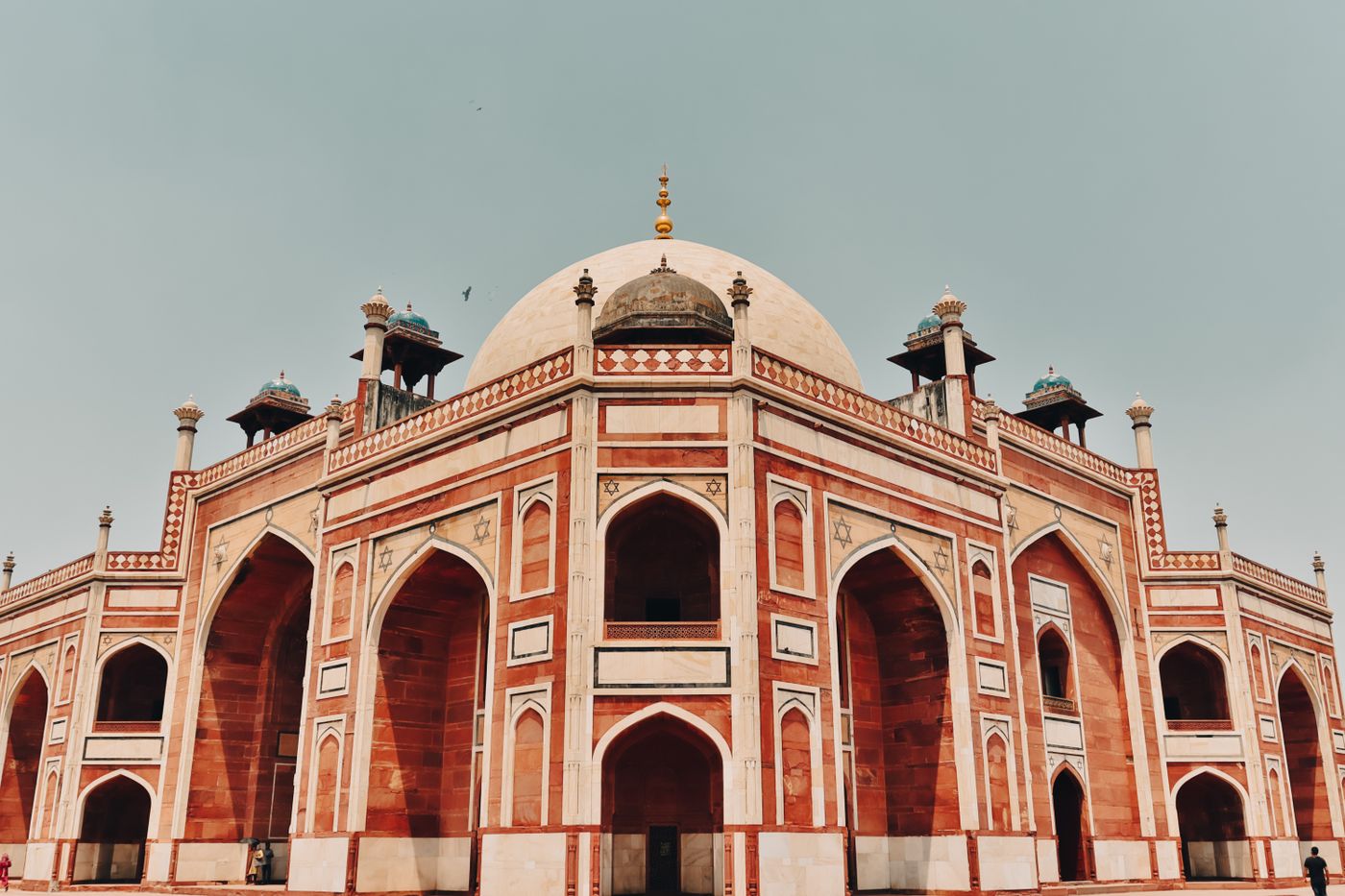
Cut in this order if time is short: Siri first, then Adilabad, then the Purana Qila lake and light show, then the Red Fort interior — the museums inside are thin and the courtyards get shoulder to shoulder by 11am, while Jama Masjid across the road gives you the better view of the same city for nothing. Do not try to fold Humayun's Tomb into this itinerary as a ruined capital; it is a garden tomb, gloriously maintained, and belongs to a different kind of day.
Questions, answered
Can I buy one ticket that covers all the Delhi ruins?
No. There is no combined pass for Delhi. Each Archaeological Survey of India site sells its own ticket at the gate or online, typically ₹25 to ₹40 for Indian nationals and ₹300 to ₹600 for foreign visitors. Mehrauli Archaeological Park, Begumpur Masjid, Khirki Masjid and Satpula are free.
Is it safe to walk Tughlaqabad or Mehrauli alone?
In daylight, yes, with sense. Go between 7am and 11am when other walkers and joggers are around, stay on visible paths, and avoid the far southern bastions of Tughlaqabad if the site is deserted. Monkeys are the real risk: carry no visible food and no dangling snacks bag.
Which months are best for this itinerary?
Mid-November to early March. December and January mornings sit around 7C to 15C, perfect for four hours on open stone, though fog can delay a sunrise start. Avoid mid-April to June, when afternoons reach 43C to 45C and shadeless sites like Tughlaqabad become genuinely dangerous by 10am.
Doing good is the business: every booking through Stay New Delhi funds one verified tonne of carbon removal — same room, same price, no markup.
Start Your Search