Delhi's seven cities in two days: a stop-by-stop route from Lal Kot to Shahjahanabad
Eight centuries and seven capitals in the order they were actually built, across roughly 46 km of driving and two long days that start at 08:00.
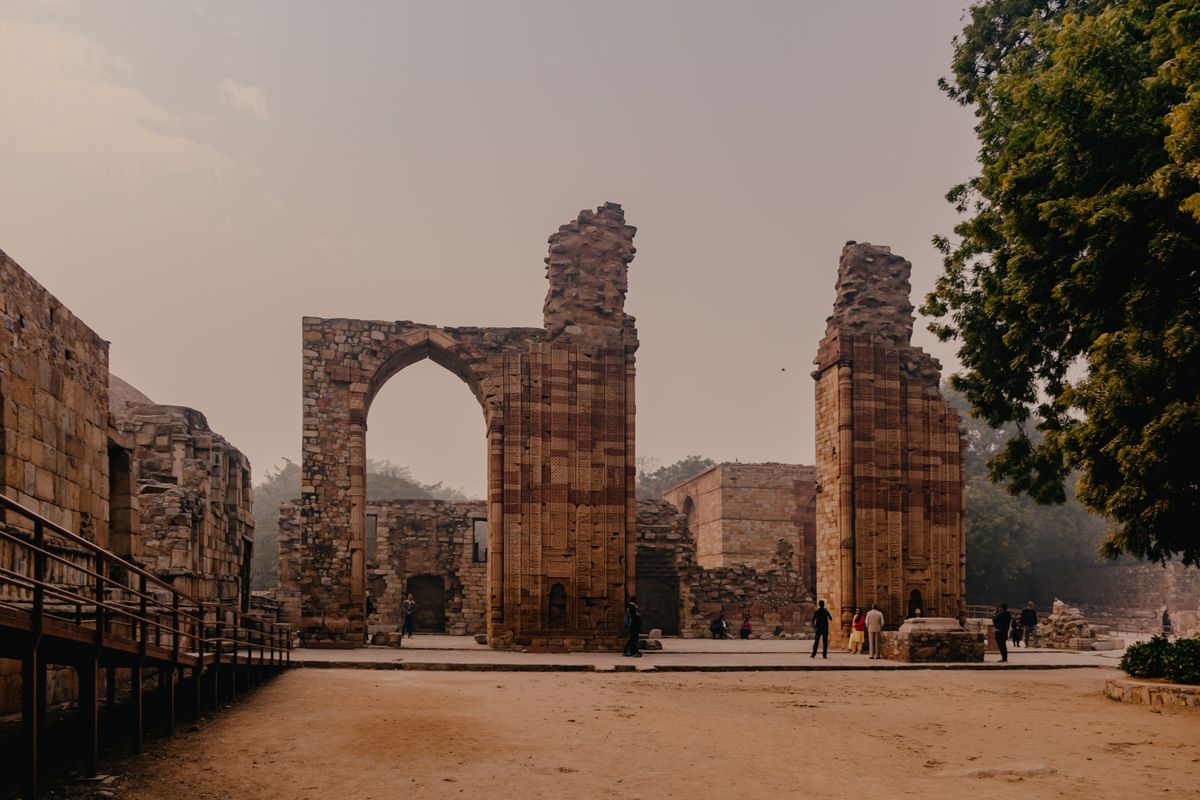
How the route works, and why chronology beats geography
Most Delhi sightseeing bounces between monuments by postcode. This route follows the city's own timeline instead: Lal Kot in the far south around 1060, then Siri, Tughlaqabad, Jahanpanah, Firozabad, Shergarh and finally Shahjahanabad up north in the 1640s. The payoff is that the architecture explains itself as you go — you watch rubble masonry give way to red sandstone, sloping Tughlaq walls straighten into Mughal arcades, and the tomb chamber grow from Balban's bare cell to Humayun's dome. Day one runs south, day two runs from the middle of the city to the walled north.
Practicalities. You need a car or app cabs for both days; the metro covers three of the seven sites and none of the connections between them. Budget ₹2,500 to ₹3,500 for a full day of app cabs, or ₹3,500 to ₹4,500 for a chauffeured car with a 10-hour, 100 km limit, which is the better buy on day one. Ticketed ASI sites here charge about ₹40 for Indian nationals and ₹600 for foreign visitors; several stops on this list are free and unstaffed. Do this route between late October and mid-March or not at all.
Day 1, 08:00 to 11:30: Lal Kot and the Mehrauli scatter
Start at the Qutub complex the moment it opens at sunrise, when the tour buses are still on the highway. Ninety minutes covers the minar, the Quwwat-ul-Islam mosque built from twenty-seven dismantled temples, the fourth-century iron pillar and Alauddin Khalji's unfinished Alai Minar stump. That stump is the point of the stop: it is the physical evidence of an emperor who intended to out-build his predecessor and died first. The city around it, Lal Kot and its Rajput extension Qila Rai Pithora, survives as low broken ramparts you can trace along the road towards Sanjay Van.
At 10:00 cross the road to Mehrauli Archaeological Park, which is free, largely unsigned and holds around forty structures in 200 acres. Head for Balban's tomb, the first true arch in India and a plain roofless chamber that makes the ambition of the Qutub next door look sudden. Then Jamali Kamali's mosque and its painted tomb chamber, and Rajon ki Baoli, a stepwell dropping four storeys into cool shade. Wear shoes you can scramble in; the paths are dirt and thorn. Allow 90 minutes. Skip the Metcalfe folly if the light is going.
Day 1, 12:00 to 16:00: Siri, Jahanpanah and lunch
Siri, the second city, is the hardest to see because Delhi built over it. What survives are chunks of its wall inside Shahpur Jat village and the Siri Fort woods, plus the tank at Hauz Khas that Alauddin Khalji dug to water it. Go to Hauz Khas Village at 12:00: the madrasa and Firoz Shah's tomb wrap two sides of the reservoir, and the L-shaped colonnade of student cells is the best-preserved medieval teaching building in the city. Eat lunch here, ₹500 to ₹1,200 a head, and use the toilets, because the next three stops have none.
At 14:00 drive 15 minutes to Jahanpanah, Muhammad bin Tughlaq's attempt to enclose everything between Siri and Lal Kot inside one wall. Two fragments are worth your time: Begumpur Masjid, an enormous empty courtyard mosque behind a residential colony, where you will usually be the only visitor; and Bijay Mandal, the ruined palace platform from which the sultan is said to have reviewed his army. Chor Minar, in Hauz Khas Enclave, is a five-minute stop — a tower pierced with 225 holes that once displayed severed heads. Nobody sells tickets at any of these.
Day 1, 16:15 to sunset: Tughlaqabad, and where to sleep
Finish the day at Tughlaqabad, 20 minutes east, because it is huge and it wants low sun. Ghiyasuddin Tughlaq threw up 6.5 km of battered stone walls in roughly four years from 1321; the city inside was abandoned within fifteen. You will not see a quarter of it in the 90 minutes before closing, so walk the southern ramparts for the view over the causeway to the sultan's red sandstone tomb across the road, then cross for the tomb itself. Monkeys work the site in troops. Carry nothing in your hands, especially food or bright plastic bottles.
Sleep south. Saket, Hauz Khas and Greater Kailash put you 20 minutes from the day-one sites and on the Yellow and Magenta lines for day two, with mid-range guesthouses and boutique properties at ₹3,500 to ₹7,000 and business hotels near the Saket malls at ₹7,000 to ₹12,000. Defence Colony is the other good call, slightly more expensive, better for dinner. Do not book Old Delhi for tonight: you would spend an hour of the evening crossing the city and another hour of tomorrow morning crossing back.
Day 2, 08:30 to 13:00: Firozabad and Dinpanah
Begin at Feroz Shah Kotla, the citadel of Firozabad, on Bahadur Shah Zafar Marg. The site is famous locally for a reason that has nothing to do with the sultan: every Thursday, people leave letters and lit candles in its underground chambers for the djinns believed to live there. Go early and quiet. The Ashokan pillar on the pyramid terrace, hauled here from Topra in the 1350s and re-erected as a trophy, is 2,300 years old and predates every other object on this route by a thousand years. Allow 60 minutes.
At 10:30 drive to Purana Qila, the sixth city, begun by Humayun as Dinpanah and finished by Sher Shah Suri, who threw him out of India for fifteen years. Walk the Bara Darwaza, the Qila-i-Kuhna Masjid with its inlaid mihrabs, and Sher Mandal, the octagonal library tower whose stairs killed Humayun in 1556. The excavation trench near the entrance has yielded Painted Grey Ware, which is the archaeological argument for Delhi being the Indraprastha of the Mahabharata. Lunch at 12:30 in Nizamuddin or Khan Market, both ten minutes away.
Day 2, 13:30 to 21:00: the Mughal jump to Shahjahanabad
Humayun's Tomb at 13:30 is the hinge of the whole route: the first great garden tomb in India, built by his widow Bega Begum from 1565, and the direct ancestor of the Taj. Do it as a loop — Isa Khan's enclosure, the Arab Serai gate, Bu Halima's garden, then the platform. Ninety minutes. Then either 30 minutes at Sunder Nursery next door for the restored Mughal pavilions, or straight north. Leave by 16:00 sharp, because the drive to Chandni Chowk against the evening flow takes 45 to 70 minutes and there is no shortcut.
17:00 in Shahjahanabad, the seventh city, founded 1639. Red Fort is closed Mondays and stops selling tickets around an hour before sunset, so on a late arrival make Jama Masjid the anchor instead: climb the southern minaret for ₹100 and look down at the whole grid Shah Jahan laid out. Then eat your way along the lanes for ₹400 to ₹800 a head. Sleep tonight in Old Delhi's heritage guesthouses inside the walls at ₹2,500 to ₹6,000 for atmosphere, or Connaught Place four-stars at ₹6,000 to ₹11,000 for a quiet room and an easy morning.
Tickets, guides and what to cut if you only have one day
Tickets are bought on-site or through the ASI app; carry ₹500 in small notes because card machines at gates fail regularly. Four of the seven cities cost nothing to enter — Jahanpanah, Feroz Shah Kotla is ticketed but cheap, Mehrauli park and Siri are free — so the whole two days runs under ₹1,700 per person for an Indian passport and around ₹3,000 for a foreign one, excluding transport. A licensed guide at Qutub or Humayun's Tomb costs ₹700 to ₹1,500 for an hour; worth it once, at Mehrauli, where nothing is labelled.
Compressing to one day means cutting Tughlaqabad and Jahanpanah, which hurts but is the right amputation: they are the furthest apart and the least legible. The single-day spine is Qutub at opening, Mehrauli park, Hauz Khas at lunch, Purana Qila, Humayun's Tomb, and Old Delhi at dusk. What you lose is the sense of scale — Tughlaqabad is the one site that makes fourteenth-century Delhi feel like an imperial project rather than a collection of tombs. If you can only add one thing back, add that, on a Sunday morning when the roads south are empty.
Questions, answered
Can the seven cities really be seen in one day?
You can see five. Cutting Tughlaqabad and Jahanpanah leaves Qutub, Hauz Khas, Purana Qila, Humayun's Tomb and Shahjahanabad, which is roughly 11 hours including transfers. Two days is the honest number, and it is the difference between photographing monuments and understanding why each capital moved.
How much do the tickets cost in total?
Around ₹1,700 per person on an Indian passport and about ₹3,000 on a foreign one for both days, since Mehrauli Archaeological Park, Jahanpanah, Begumpur Masjid and Chor Minar are all free. Major ASI sites charge roughly ₹40 and ₹600 respectively. Carry cash; gate card readers are unreliable.
Is Tughlaqabad safe to walk around?
Yes, in daylight and in a group of two or more. The real hazards are large monkey troops, loose rubble on the ramparts and a total absence of shade or water. Go after 16:00, carry a stick-free posture around the monkeys, and leave the site before the gate closes at sunset.
Which months suit this route?
Late October to mid-March. You are outdoors and largely unshaded for around seven hours a day; April to June brings 40 to 46°C afternoons that make Tughlaqabad and Mehrauli genuinely dangerous, and July to September turns the dirt paths in the archaeological park to mud.
Doing good is the business: every booking through Stay New Delhi funds one verified tonne of carbon removal — same room, same price, no markup.
Start Your Search