Best sunset spots in New Delhi
Delhi's sun sets anywhere between 5:25pm in late December and 7:25pm in mid-June, and half the good viewpoints lock their gates at the same moment. Here are 12 places to be at golden hour, with gate times, ticket prices and the neighbourhoods worth booking so you can walk back.
Timing: when the sun goes and when the gates shut
Sunset in Delhi swings by two hours across the year — roughly 5:25pm in the last week of December, 6:15pm in March, and about 7:25pm in mid-June. That matters because Archaeological Survey of India monuments including Humayun's Tomb, Safdarjung's Tomb and Purana Qila are ticketed "sunrise to sunset", and the counters stop selling around 30 minutes before the gate closes. In practice, staff start moving people toward the exit as the light turns. Buy online through the ASI ticketing portal, arrive at least 60 minutes before sunset, and do not plan to linger after the last call.
Season changes the picture more than the hour does. October to early November and February to March give clean gold light and comfortable evenings. From mid-November to January, smog turns the sun into a flat orange disc that photographs beautifully and burns your throat — AQI regularly runs 250 to 400, so carry an N95 mask. Monsoon evenings in July and August deliver the most dramatic skies in the city, with towering cloud over the ridge, but the ruins get slippery and gardens close early after heavy rain. Summer sunsets are late, hot and hazy.
Mughal Delhi at golden hour
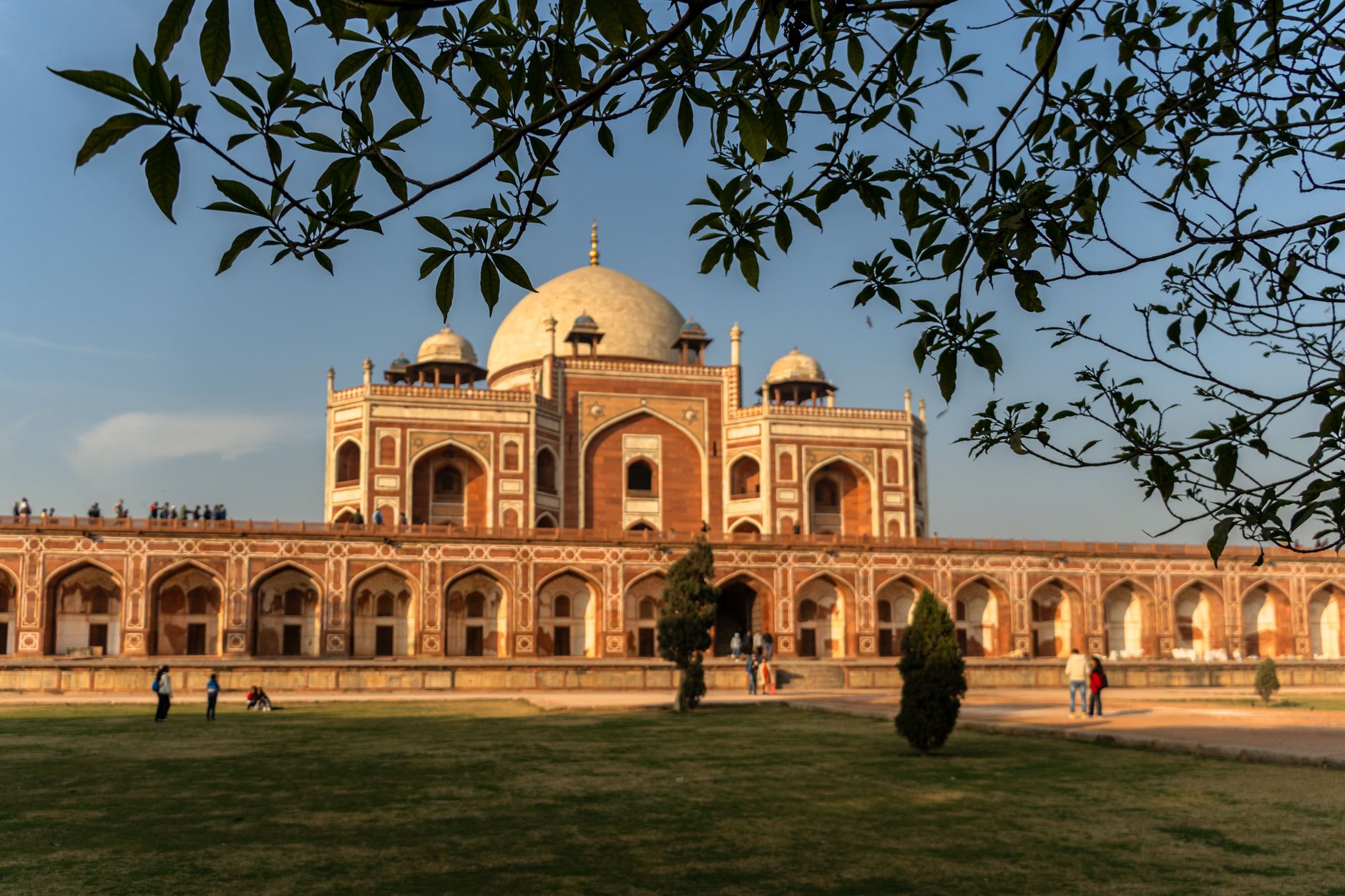
Humayun's Tomb on Mathura Road is the classic and still the best: the red sandstone plinth faces west, so the last 40 minutes turn the whole platform copper. Tickets are around ₹40 for Indian nationals and ₹600 for foreign visitors, children under 15 free, and the gate follows sunset. Enter via the Nizamuddin side, do Isa Khan's octagonal tomb first while the light is high, then climb to the main terrace. Weekends are crowded; a Tuesday evening in February is close to perfect. Nearest metro is JLN Stadium on the Violet Line, then a ₹60 to ₹90 auto.
Directly across the road, Sunder Nursery stays open later — usually to about 7pm — and costs roughly ₹50 on weekdays and ₹100 at weekends. Its central axis, lotus pond and the Sunderwala Burj make a gentler, greener sunset than the tomb, with a cafe and clean toilets, which is why families prefer it. Purana Qila on Mathura Road, ticketed at around ₹25 and ₹300, closes about 6pm; the Bara Darwaza and the Sher Mandal silhouette hard against the sky, and the boating lake outside catches the reflection for another twenty minutes after.
South Delhi: the Hauz Khas reservoir and Mehrauli
The Hauz Khas complex is the best free sunset in the city. Firoz Shah's madrasa runs along the eastern edge of a 13th-century reservoir, so you stand in stone arcades looking west across water toward the trees of Deer Park while the sun drops behind them. Entry is free and the gate closes around 7pm, earlier in winter. Take the Yellow Line to Green Park and walk ten minutes, or pay ₹40 to ₹60 for an auto — driving into Hauz Khas Village at 6pm is a parking nightmare. Come 45 minutes early to get a spot on the low wall.
Mehrauli Archaeological Park is free, unticketed and enormous, and Jamali Kamali's mosque courtyard at 5:30pm in winter is one of the quietest beautiful places in Delhi. The catch is that it is unlit and empties fast, so leave before full dark and do not walk the far paths alone. Qutub Minar closes around 5pm and is therefore a late-afternoon rather than sunset option; for the tower at dusk, book a table on one of the terraces at Ambawatta One or the courtyard at Qla in Mehrauli instead.
Central Delhi: Raisina Hill, Kartavya Path and the domes
Walk west along Kartavya Path from India Gate and the sun sets directly behind the North and South Blocks and the dome of Rashtrapati Bhavan — the single most theatrical free view in the capital, and the reason the Raisina Hill ramp is jammed with photographers on winter evenings. It is free, open air, and the fountains and floodlights come on around 7pm. Vendors sell chai at ₹20 and roasted corn at ₹30. Use Central Secretariat or Udyog Bhawan on the Yellow Line; India Gate has no metro of its own and the drop-off points are a walk away.
Two more central options. Central Park inside Connaught Place is free, has the big national flag catching the last light, and sits directly above Rajiv Chowk metro, which makes it the easy choice if you are staying in the middle of town. And once the sun has actually gone, walk 15 minutes to Gurudwara Bangla Sahib on Ashoka Road: the sarovar reflects the lit white domes, entry is free, it never closes, and the free langar means dinner costs nothing. It is the best post-sunset half hour in Delhi.
River, ridge and the wilder viewpoints
For water, head to Vasudev Ghat near Kashmere Gate, the redeveloped stretch of the Yamuna riverfront with stone steps, lamps and planted terraces — free, best from about an hour before sunset, and easy from Kashmere Gate metro where the Red, Yellow and Violet lines meet. Further south, the Kalindi Kunj barrage and the Okhla Bird Sanctuary put egrets and painted storks against the water at dusk; the sanctuary charges a small entry fee and shuts around 5:30pm, so treat it as a late-afternoon trip rather than a sunset one.
For height and quiet, the Northern Ridge near Delhi University has Flagstaff Tower and the Chauburji mosque among the trees, free and open in daylight. The Aravalli Biodiversity Park at Vasant Kunj and Sanjay Van behind Mehrauli both give you scrub forest and open sky with almost no buildings in frame. All three empty out at dusk, are unlit, and have poor mobile reception in patches — go in pairs, keep your phone in your pocket on empty trails, and be at the gate before it closes.
Paid views: rooftops, terraces and hotel bars
Cirrus 9 on the 25th floor of The Oberoi, Dr Zakir Hussain Marg, is the highest proper bar view in central Delhi, looking over the Delhi Golf Club and Humayun's Tomb; expect ₹1,200 and up per cocktail and a smart dress code. Qla in Mehrauli puts you in a lantern-lit courtyard with the Qutub Minar visible over the wall, and works better at 6pm than at 10pm. Aerocity's Worldmark blocks and the terraces at Roseate House and Andaz Delhi offer sunset over the airport approach, which is more interesting than it sounds if you like watching aircraft.
Cheaper terraces exist and are honest about what they are. The rooftop cafes above Hauz Khas Village overlook the reservoir with beer around ₹350 to ₹500 and no minimum spend before 7pm. Paharganj's Main Bazaar guesthouses stack rooftop restaurants four floors up where a thali runs ₹250 and chai ₹30, with a rough but genuine view over water tanks, the railway and a lot of sky. Nizamuddin East rooftops, where a few small hotels have terraces, look straight at Humayun's dome for the price of a room.
Where to stay for sunsets you can walk to
Nizamuddin East is the specialist choice: Humayun's Tomb, Sunder Nursery and the dargah are all within a 15-minute walk, and family-run guesthouses and small boutique hotels run roughly ₹4,000 to ₹8,000 a night. Sunder Nagar next door is quieter and slightly pricier. If you want the Lutyens sunset — Kartavya Path, Lodhi Garden, Safdarjung's Tomb — book Jor Bagh or the Khan Market fringe, where honest rooms start around ₹9,000 and rise fast, or Lodhi Colony's guesthouses a little below that.
For the southern viewpoints, Hauz Khas at about ₹2,500 to ₹6,000 puts the reservoir five minutes from the door and is the best value sunset base in Delhi; ask for a room away from the village lane if you plan to sleep before 1am. Mehrauli's boutique properties, ₹6,000 to ₹12,000, wake up beside the archaeological park. Paharganj at ₹900 to ₹2,000 buys you a rooftop and not much else. Wherever you stay, check sunset time the night before and leave 45 minutes of slack for Delhi traffic.
Questions, answered
What time does the sun set in Delhi?
It ranges from about 5:25pm in late December to about 7:25pm in mid-June, with roughly 6:15pm in March and 6:45pm in September. Because ASI monuments close at sunset and stop selling tickets around 30 minutes earlier, check the exact time for your date and aim to be inside at least an hour beforehand. Winter sunsets come with heavy smog, which changes the light dramatically.
Can you visit Humayun's Tomb at sunset?
Yes, and it is the best time to be there, but the gate closes at sunset and the ticket counter shuts roughly half an hour before. Tickets are about ₹40 for Indian nationals and ₹600 for foreign visitors; buy online to skip the queue. Arrive 60 to 90 minutes early so you can see Isa Khan's tomb and the Arab Serai before the light drops on the main platform.
Where can I watch the sunset in Delhi for free?
The Hauz Khas complex above the reservoir, Kartavya Path looking west toward Rashtrapati Bhavan, Lodhi Garden, Mehrauli Archaeological Park, the Northern Ridge and Vasudev Ghat on the Yamuna all cost nothing. Hauz Khas and Kartavya Path are the two with genuinely open western horizons. After dark, Gurudwara Bangla Sahib is free, open around the clock, and its lit domes reflected in the tank are worth the walk.
Is Hauz Khas complex free and what time does it close?
Entry to the Hauz Khas complex — the madrasa, tomb and reservoir edge — is free. Gates typically close around 7pm, earlier in the short winter days, and staff clear the terraces at closing. The adjoining Deer Park is also free and shuts around the same time. Come via Green Park metro on the Yellow Line, as parking inside Hauz Khas Village at dusk is close to impossible.
Are Delhi rooftop bars expensive at sunset?
The hotel rooftops are: Cirrus 9 at The Oberoi and comparable venues start around ₹1,200 per cocktail, often with a minimum spend and a dress code. Neighbourhood terraces are far cheaper — Hauz Khas rooftops do beer at ₹350 to ₹500, and Paharganj rooftop restaurants serve a thali for about ₹250. Sunset slots at the good places fill up in the cool season, so reserve two or three days ahead.
Is India Gate worth visiting at sunset or after dark?
Both, and it is free. Go 45 minutes before sunset to walk Kartavya Path westward while the sun drops behind Rashtrapati Bhavan, then stay for the floodlights and fountains, which usually come on around 7pm. The lawns stay busy and well policed late into the evening. Nearest metro stations are Central Secretariat and Udyog Bhawan on the Yellow Line, about a 15-minute walk away.
Doing good is the business: every booking through Stay New Delhi funds one verified tonne of carbon removal — same room, same price, no markup.
Start Your Search