Dilli Haat INA
A ticketed open-air craft village where the stalls rotate every fortnight and every Indian state runs a food kiosk — the least stressful shopping in Delhi, and the only place you can eat Nagaland and Rajasthan in the same hour.
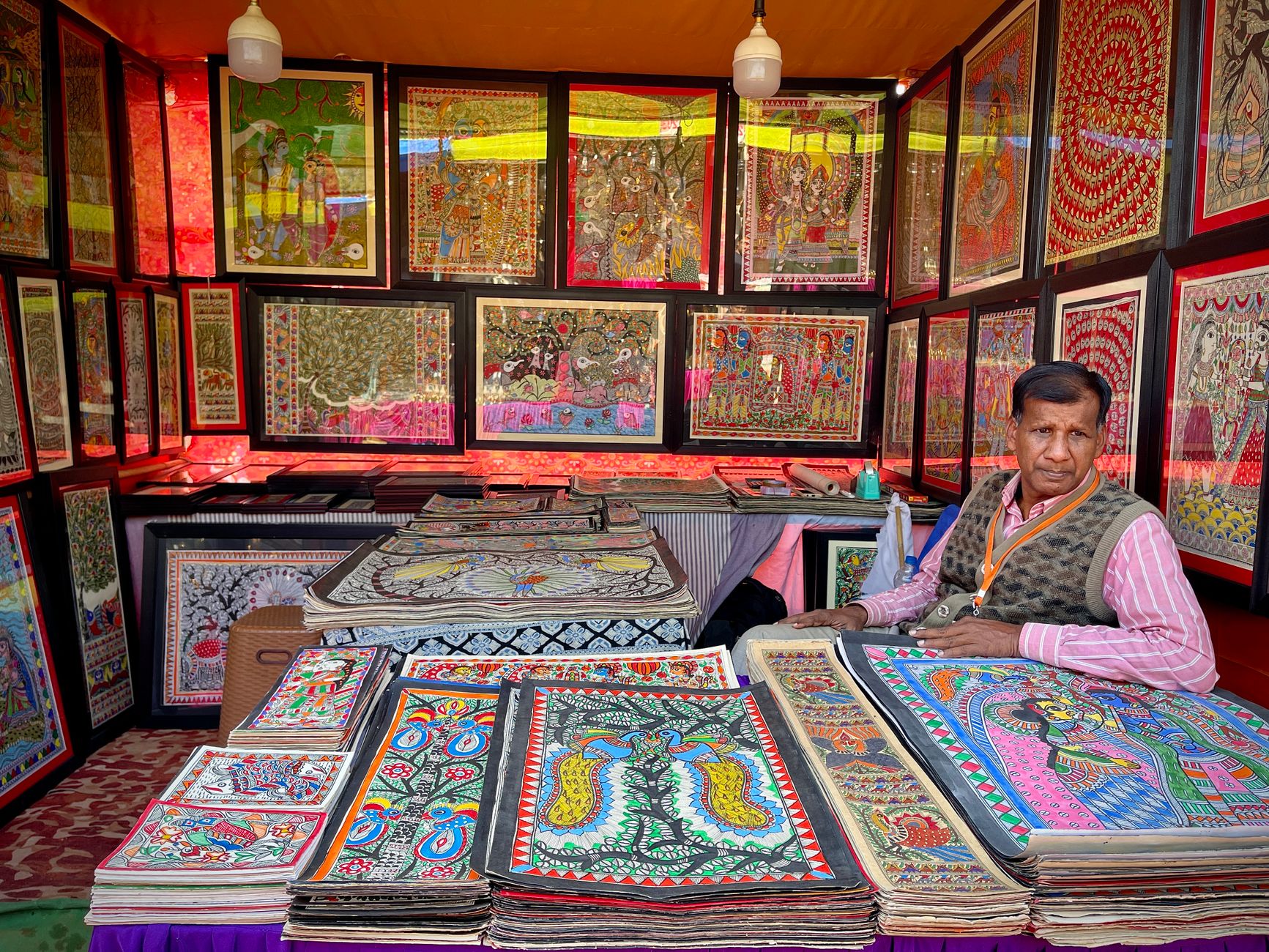
Dilli Haat opened in 1994 on a strip of land opposite INA Market, built by Delhi Tourism as a permanent version of the village haat — a weekly market — with brick paving, thatched kiosks and shade trees instead of a shopping mall. It works on a rotation system that is the whole point: around sixty craft stalls are allotted to artisans from across India for fifteen days at a time, so the Kashmiri papier-mâché seller you met in March has been replaced by a Bhil painter from Madhya Pradesh by April. Down one side runs a line of state food stalls, each run by that state's tourism body or a licensed operator, serving momos from Sikkim, litti chokha from Bihar, dhokla from Gujarat and Kashmiri wazwan. It is the only place in the city where handicraft prices are fixed enough to be sane and the sellers are the makers.
A visit is a slow loop. You buy a ticket at the gate, pass a security check, and walk into a courtyard that feels a full ten degrees cooler than Aurobindo Marg outside. The craft rows run in a rough horseshoe: textiles and shawls at one end, brassware and dhokra metalwork in the middle, beads, leather juttis, cane furniture and Channapatna wooden toys along the far side. Prices are marked but negotiable by maybe ten to twenty percent, and no one grabs your sleeve. The food strip is the second half of the visit — plastic chairs, a shared seating area, numbered kiosks, and portions large enough that two people can share three dishes. There is a small open stage where folk musicians and dance troupes perform on some evenings and through state festival weeks.
Plan two to three hours and come hungry. There is no need to book anything; you buy the entry ticket at the counter and pay each stall separately. What to skip: the mass-produced pashmina-style shawls near the entrance, which are the same acrylic goods sold on Janpath, and any stall that will not tell you where the piece was made. What to prioritise: whatever state is currently in residence, the momo stall queue at kiosk row, and the Kashmiri kahwa or Rajasthani gatte ki sabzi if you see them. Carry cash for the small artisans, though almost every stall now takes UPI. Bags are allowed; large luggage is not, and there is no cloakroom, so this is not a place to fill a two-hour gap on the way to the airport with suitcases in tow.
Getting there is unusually simple for Delhi: INA metro station sits directly across the road, served by both the Yellow Line and the Pink Line, and the subway exit surfaces within sixty metres of the Dilli Haat gate. From Rajiv Chowk in Connaught Place it is six stops south on the Yellow Line, about fourteen minutes, fare roughly ₹30-40. From the airport, take the Airport Express to New Delhi and change to the Yellow Line, or a cab in about 30-40 minutes for ₹350-500 depending on traffic. Auto-rickshaws from Hauz Khas or Defence Colony run ₹80-150. If you drive, there is paid parking on the Aurobindo Marg side charging around ₹20-40 for the first hours, but it fills solid on weekend evenings and the alternative is a long, unpleasant walk along a busy arterial road.
Entry is ₹30 for adults and ₹20 for children under twelve, with a higher rate of about ₹100 for foreign nationals; tickets are sold at the gate counter and there is no online booking. Once inside, nothing else is compulsory. Food is the real spend: a plate of momos ₹120-180, a Bihari litti chokha thali around ₹200-250, Kashmiri rista or rogan josh ₹350-450, kahwa or masala chai ₹40-80. Crafts range from ₹150 for a pair of beaded earrings to ₹2,000-6,000 for a good Kutch embroidery panel or a dhokra figure, and well into five figures for pashmina and carpets. Budget ₹800-1,200 a head for entry, a substantial meal and a small souvenir. Card and UPI work at most kiosks; the ticket window prefers cash.
Come on a weekday for space and on a weekend evening for atmosphere — they are two different places. Weekday mornings from 10:30 to about 13:00 are near-empty, which is the best time to actually talk to artisans. Weekday evenings after 18:00 fill with office crowds eating dinner. Saturday and Sunday from 17:00 onwards is packed, with queues at the popular food kiosks and every seat taken. October to March is the season: the courtyard is open to the sky and pleasant in cool weather, and the winter craft rotations bring the strongest Kashmiri and Himachali stalls. April to June is hot even after dark; the monsoon months make the seating area soggy. The market opens every day of the year, including public holidays.
It suits families with young children better than almost anywhere else in central Delhi — flat paving, no traffic, safe to let a child walk ahead, food they will actually eat, and toys for sale. It suits wheelchair users reasonably well by Delhi standards: the main paths are paved and level, though the food seating area gets tightly packed and the toilets are not adapted. It suits shoppers who hate haggling and travellers wanting one place to buy gifts for everyone at home. It is less good for anyone hoping for an unpolished, authentic street bazaar — this is a curated, managed enclosure — and it is a poor plan in a downpour, since most of the site is open air.
Nearby, INA Market is directly across the road, a five-minute walk, and worth a look for fish, imported groceries and produce; Safdarjung's Tomb is about 1.5 km north, ten minutes by auto; Sarojini Nagar's bargain clothing market is 2 km west and pairs naturally with a Dilli Haat lunch. The honest caveats: the stall rotation means the thing you loved last visit will not be there, and no one can tell you in advance which states are coming; a share of the goods near the entrance is commercial stock rather than artisan work, so look for the maker; and the toilets and general upkeep have declined in recent years, which is the most common complaint from returning visitors. Come for the food and the makers, not for a perfect facility.
Hours & entry
Not free
Daily 10:30-22:00 · Food stalls take last orders around 21:30 · Craft stalls change over on the 1st and 16th of each month
What to see
{'what': 'State food kiosk row', 'where': 'Along the eastern edge of the courtyard, past the craft horseshoe'}
{'what': 'Fortnightly rotating craft stalls', 'where': 'Central and far rows, numbered stalls allotted for 15 days'}
{'what': 'Open-air performance stage', 'where': 'Amphitheatre space near the middle of the complex'}
Tips from the ground
Come on a weekday before 13:00 to talk to artisans without a crowd behind you.
The stall rotation changes on the 1st and 16th — visit just after for a fresh line-up.
Buy the ticket with cash; the gate counter is slow with cards.
Questions, answered
How much is entry to Dilli Haat INA?
Entry is ₹30 for adults and ₹20 for children under twelve, with a separate rate of about ₹100 for foreign nationals. Tickets are sold only at the gate counter in cash, and there is no online booking or advance ticket. Nothing else inside is compulsory, but budget ₹800-1,200 a head if you plan to eat properly at the state food stalls and buy a small piece of craft work.
Are there free entry hours?
No. Dilli Haat charges the same ₹30 adult ticket from opening at 10:30 to closing at 22:00, every day of the year, with no free evenings, free Sundays or concession windows beyond the child rate. Occasional state festival launches are ticketed as normal. If you want a market with no charge at all, Sarojini Nagar is 2 km west and INA Market is directly across the road, both free to enter.
How long do people spend there?
Two to three hours is typical: about an hour walking the craft horseshoe, then a long meal at the food stalls. Serious shoppers stay longer, especially when a strong textile state is in residence. If you are only eating, ninety minutes covers a queue, a table and two or three dishes. It is compact enough that you will not need to plan a route — one loop of the courtyard takes in every stall.
Is Dilli Haat closed on any day?
No. It opens daily from 10:30 to 22:00, including Sundays and most public holidays, which makes it a useful fallback on Mondays when Sarojini Nagar shuts and on Sundays when Khan Market and much of Chandni Chowk closes. Individual food kiosks occasionally take a day off, and craft stalls are quiet on the 1st and 16th of each month when the fortnightly changeover happens.
Do I need to book in advance?
No booking exists and none is needed. You buy the entry ticket at the gate, walk in, and pay each stall directly by cash or UPI. Food stalls do not reserve tables — seating in the shared eating area is first come, first served, and on Saturday evenings after 19:00 you may wait ten minutes for a chair. Guided craft tours are not run here; the artisans explain their own work if you ask.
Which metro station is nearest?
INA, served by both the Yellow Line and the Pink Line, is directly opposite the entrance — under a minute from the subway exit. From Rajiv Chowk in Connaught Place it is six stops and about fourteen minutes for roughly ₹30-40. Coming from Hauz Khas or Saket, stay on the Yellow Line northbound. Paid car parking on Aurobindo Marg costs around ₹20-40 but fills completely on weekend evenings.
Doing good is the business: every booking through Stay New Delhi funds one verified tonne of carbon removal — same room, same price, no markup.
Start Your Search