Feroz Shah Kotla
The ruined citadel of Firozabad, crowned by a third-century BCE Ashokan pillar that a sultan had dragged here on a forty-two-wheeled cart — and still, every Thursday, a place where people leave letters for djinns.
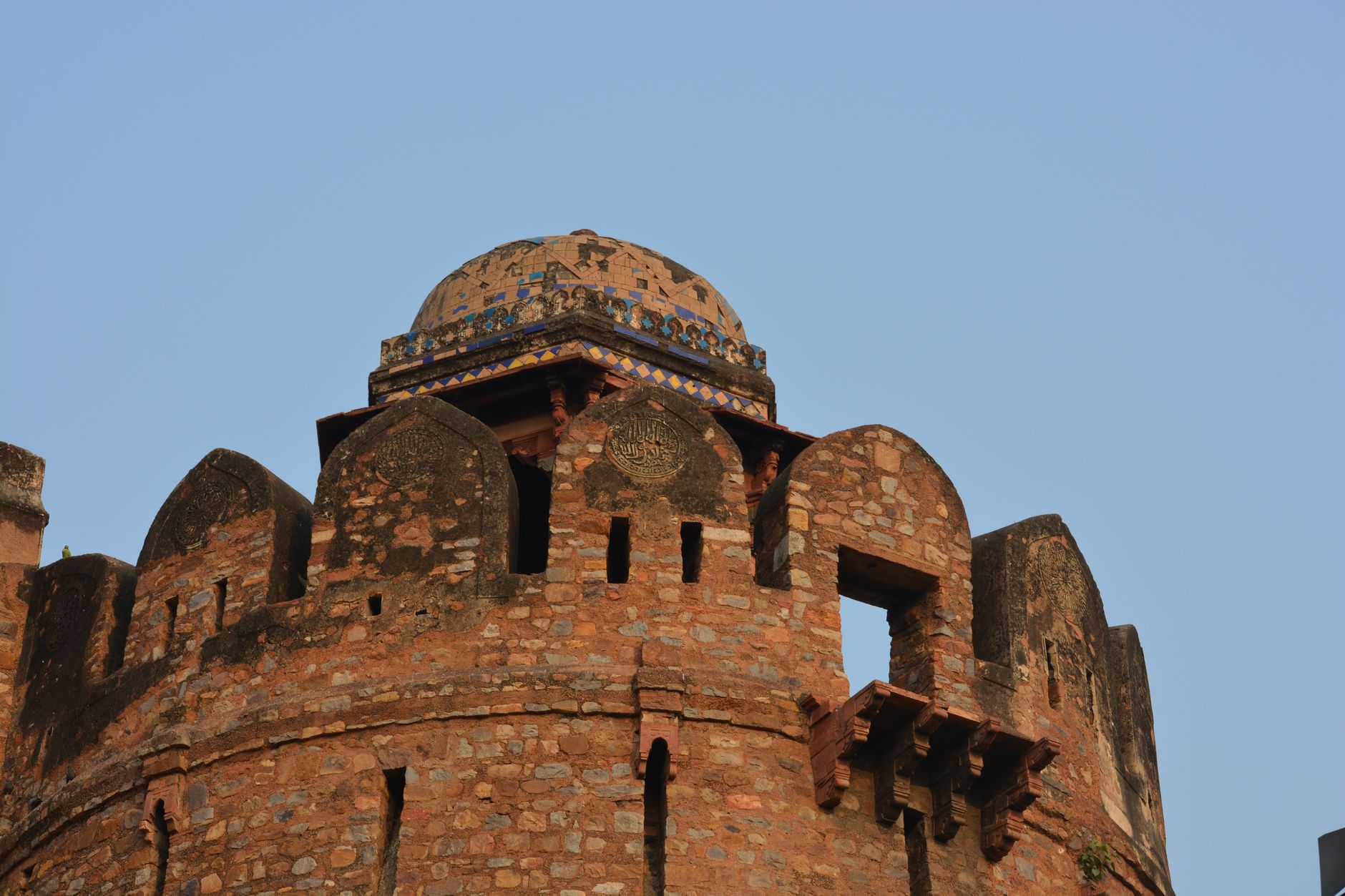
Feroz Shah Kotla is the surviving citadel of Firozabad, the fifth city of Delhi, founded by Firoz Shah Tughlaq in 1354 on the bank of the Yamuna. What remains is a walled precinct containing a congregational mosque, a large circular baoli, ruined palace ranges, and a stepped pyramid of three tiers carrying a polished sandstone pillar of Ashoka. That pillar, about 13 metres tall and inscribed with the Mauryan emperor's edicts in Brahmi, dates from around 250 BCE and originally stood at Topra in present-day Haryana; Firoz Shah had it moved in 1356 by river and cart, an operation described in contemporary accounts as requiring a specially built carriage. The inscription was not deciphered until James Prinsep's work in 1837. The site is also known for a living folk practice: since the 1970s, visitors have left written petitions and offerings in the vaults, addressed to djinns believed to inhabit the ruins.
Walking round takes an hour. From the gate the path leads past lawns to the Jami Masjid, once one of the largest mosques in Delhi and now a shell of arcaded walls on a high plinth, reached by a broad flight of steps; Timur is said to have admired it in 1398 and taken masons back to Samarkand. The stepped pyramid stands north of the mosque, and you can climb the tiers to stand beside the Ashokan pillar, which is fenced but close. Beneath and around it run vaulted chambers, dim and cool, where candles, incense and folded letters accumulate. The circular baoli lies to the northwest, usually with water in it and off limits to descend. Between the structures the ground is grass and rubble, with the Ferozeshah Kotla cricket stadium wall visible beyond.
One to two hours is right, and Thursday is the day that changes the visit. On Thursday afternoons the vaults fill with people making offerings, and the atmosphere is completely different from the quiet weekday ruin — worth seeing, if you are respectful, and worth avoiding if you want an empty site to photograph. Carry a torch for the underground chambers; they are unlit. Wear shoes you can take off if you enter areas being used for prayer. Do not move or photograph people's petitions without asking. The site has almost no interpretation beyond one or two ASI boards, so read about Firozabad and the pillar transport before you come.
Delhi Gate on the Violet Line is the nearest station, 700 metres northwest — about nine minutes on foot along Bahadur Shah Zafar Marg. From Rajiv Chowk that is roughly 15 minutes and ₹30, changing at Central Secretariat or Mandi House depending on your route. ITO station is about 1 km south. Many buses run along Bahadur Shah Zafar Marg and stop at Feroz Shah Kotla, right outside. By car the entrance is on Bahadur Shah Zafar Marg with a small ASI parking area charging around ₹20-30; the road is heavily trafficked and the turn is easiest coming from the Delhi Gate direction. An auto from Connaught Place is ₹70-100 and takes 15 minutes; from Old Delhi railway station about ₹80.
Entry costs ₹25 for Indian nationals and SAARC and BIMSTEC citizens, and ₹300 for other foreign nationals, with a small online saving on the ASI portal. Children under 15 enter free. That admits you to the whole enclosure — mosque, pyramid, pillar, baoli exterior and the vaults. A video camera permit is ₹25. Nothing inside is separately charged, and there is no café or shop; a few vendors outside the gate sell flowers, incense and candles used for the Thursday offerings, at ₹20-50. The cricket stadium next door, Arun Jaitley Stadium, is an entirely separate venue with its own match tickets and is not connected to the monument in any way.
Weekday mornings are quiet enough that you may have the mosque plinth to yourself; that is the best time for photography, with side light on the pyramid from about 08:00 to 10:00. Thursday from roughly 14:00 onwards is the busiest and most interesting time socially. Weekends are moderately busy. The site opens daily including Mondays, 07:00 to 17:00. November to February is the comfortable season; December fog softens the ruins nicely but hides the pillar top until mid-morning. April to June is hot and there is very little shade except in the vaults, which stay cool. During the monsoon the vaults can flood at the lowest levels and the lawns become muddy.
It suits people who like ruins with a living story attached, photographers, and anyone curious about folk religion in a modern city. It is not a comfortable site for wheelchair users: the mosque plinth and the pyramid are reached only by steps, though the lawns and lower paths are manageable. Families with small children should watch the unfenced drops around the plinth and the dark vault stairs. Teenagers usually find the djinn letters more compelling than the architecture. On a rainy afternoon the vaults offer shelter but the rest is exposed. For a one-hour gap between Old Delhi and Connaught Place it works well, being close to both.
Nearby, Delhi Gate itself is a nine-minute walk northwest; the National Gandhi Museum and Raj Ghat are about 1.5 km northeast; Old Delhi's Chandni Chowk lanes and Jama Masjid are 2.5 km north, a ₹60-80 auto; and Connaught Place is 3 km west for lunch. Honest caveats: the site is genuinely ruinous, with little standing above plinth level apart from the mosque walls and the pyramid, and visitors expecting a fort in the Red Fort sense are always disappointed; the Ashokan pillar is fenced and cannot be touched or closely read; the Thursday crowd makes quiet contemplation impossible; and it is frequently confused with the adjacent cricket ground of the same name, which is a separate ticket and a separate world.
Hours & entry
Not free
Daily 07:00-17:00 · Ticket counter closes 16:30 · Busiest on Thursday afternoons
What to see
{'what': 'Ashokan pillar of c. 250 BCE', 'where': 'Top tier of the stepped pyramid, north of the mosque'}
{'what': 'Vaulted chambers with djinn petitions', 'where': 'Beneath the pyramid, accessed from the west side'}
{'what': 'Jami Masjid plinth and arcades', 'where': 'Southern half of the enclosure, up the broad stair'}
Tips from the ground
Bring a torch — the underground chambers under the pillar are unlit.
Thursday afternoon is when the vaults come alive with offerings; weekday mornings are best for photographs.
Do not confuse the monument with Arun Jaitley (Ferozeshah Kotla) cricket stadium next door.
Questions, answered
What is the ticket price at Feroz Shah Kotla?
₹25 for Indian nationals and SAARC and BIMSTEC citizens, ₹300 for other foreign nationals, slightly less booked on the ASI e-ticketing portal. Children under 15 enter free. The ticket covers the mosque, the stepped pyramid, the Ashokan pillar, the baoli exterior and the vaults. A video camera permit is ₹25. Vendors outside sell candles and incense for the Thursday offerings at ₹20-50, which is the only other thing you might spend money on here.
Are there free entry hours?
No. The charge applies throughout the 07:00-17:00 opening, seven days a week, with no free window, free Thursday or evening concession, despite the Thursday religious gathering. Only children under 15 enter free as a matter of course. The ASI has waived entry across ticketed sites on World Heritage Day, 18 April, in some years, but that is announced late. Budget the ₹25 or ₹300 and buy at the counter or online.
How long should I spend?
One to two hours. Forty-five minutes covers the mosque plinth, the pyramid and the Ashokan pillar. An hour and a half lets you explore the vaults with a torch, walk out to the circular baoli and take in the ruined palace ranges. Add half an hour if you visit on a Thursday afternoon, when the vaults are busy and the atmosphere is worth lingering over. Delhi Gate metro is only nine minutes' walk away.
Which day is it closed?
None. Feroz Shah Kotla opens daily from 07:00 to 17:00, Mondays and public holidays included, with the ticket counter closing about 16:30. Thursdays are open as normal and are the busiest day because of the offerings left in the vaults. Individual vault chambers can be closed off after heavy monsoon rain when the lowest levels flood, and conservation work occasionally fences part of the mosque plinth.
Do I need to book in advance?
No. Visitor numbers are modest and the counter queue is rarely more than a couple of minutes, even on Thursday. An ASI e-ticket is convenient and marginally cheaper if you are already buying tickets for other monuments the same day. There are no timed slots, no daily cap and no official guides stationed here, so if you want interpretation, arrange a heritage walk in advance rather than expecting one at the gate.
What is the nearest metro station?
Delhi Gate on the Violet Line, about 700 metres northwest — roughly nine minutes' walk along Bahadur Shah Zafar Marg. From Rajiv Chowk allow around 15 minutes and ₹30 with a change at Central Secretariat or Mandi House. ITO station is about 1 km south. Buses along Bahadur Shah Zafar Marg stop directly outside the gate, and there is a small ASI parking area for around ₹20-30 if you drive.
Doing good is the business: every booking through Stay New Delhi funds one verified tonne of carbon removal — same room, same price, no markup.
Start Your Search