Garden of Five Senses
Twenty acres of sculpture, rock terraces and Mughal-inspired water gardens built into the Delhi ridge at Saket — a designed park meant to be touched, smelled and climbed rather than simply looked at.
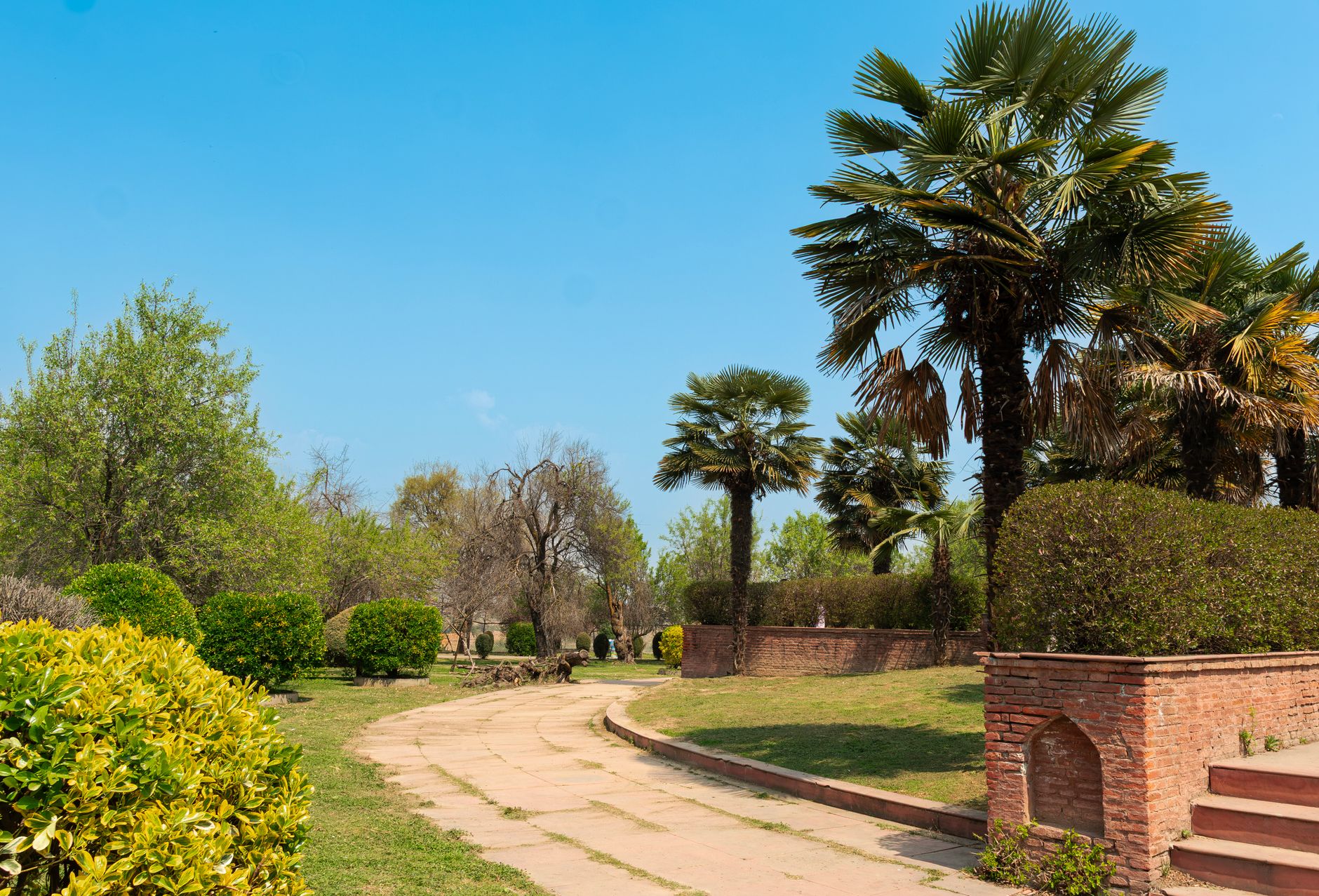
The Garden of Five Senses opened in February 2003 on about twenty acres of rocky ridge land at Said-ul-Ajaib, just west of Saket, and it is the rare Delhi park that was designed rather than inherited. Delhi Tourism commissioned it and the architect Pradeep Sachdeva laid it out around a simple idea: a garden that engages sight, sound, smell, touch and taste instead of being a lawn with a fence. The site was quarried, scrubby Aravalli outcrop before work began, and the boulders were kept and built into the design, so the ground rises and falls in terraces of natural rock rather than being flattened. It holds a Mughal-inspired formal garden called Khas Bagh, a solar energy park, a spiral walkway climbing the ridge, a Courtyard of the Colour, and dozens of commissioned sculptures and installations placed along the paths.
A visit is a loop rather than a checklist. From the entrance plaza the paths fan out: one climbs the rocks past metal and stone sculptures to a high point with a view across south Delhi's tree cover; another drops into Khas Bagh, with its channels, fountains and bougainvillaea-covered pergolas, the most photographed corner of the park; a third leads through the herb and flowering beds where the scent planting is concentrated. Chimes, wind installations and water noise are used deliberately along the way. There are open-air performance spaces used for festivals, a food and shopping court near the entrance with restaurants and cafés, and long stretches of shaded seating built into the rock. It is compact enough that you will not get lost and varied enough that you will not get bored.
Ninety minutes to two hours does it. Come in the late afternoon if you want photographs, because the low sun on the rock terraces and the bougainvillaea is what people come for, and because the food court is livelier towards evening. Nothing needs booking for ordinary entry. Skip the solar energy park unless you have children who like machinery, and skip the whole idea in the middle of a May afternoon — the rock holds heat and the shade is patchy. If a festival is on, the Garden Tourism Festival in February being the biggest, expect the central spaces to be given over to stalls and stages, which is either the reason to come or the reason to stay away depending on what you want.
It is a straightforward metro trip. Saket station on the Yellow Line is about 1.5 km away, roughly a ₹40-60 auto or a 20-minute walk along Press Enclave Road and into Said-ul-Ajaib; Chhatarpur, also Yellow Line, is about 2.5 km on the other side. From Rajiv Chowk the fare to Saket is around ₹40-50 with a ride of about 30 minutes. Buses on Press Enclave Road and Mehrauli-Badarpur Road cost ₹10-25. Driving from central Delhi is 16-18 km and takes 40-60 minutes depending on the Ring Road; there is paid parking at the entrance, which fills on weekend evenings. App cabs from Connaught Place run roughly ₹300-450. The lane approach through Said-ul-Ajaib is narrow, so allow a few extra minutes at the end.
Entry is about ₹35 for adults and around ₹15 for children, senior citizens and students carrying valid identification, sold at the gate window. It is one of the cheapest ticketed attractions in the city and there is no combined ticket with anything else. Inside, everything except food is included: the sculpture trail, the gardens, the walkways and the amphitheatres are all covered by the entry ticket. What costs extra is the food and shopping court by the entrance, where restaurant meals run roughly ₹400-900 a head and a coffee ₹150-250. Handheld phone and camera photography is included in the ticket; professional shoots, tripods and pre-wedding sessions require prior permission from Delhi Tourism and a separate fee. Parking is charged at the gate.
October to March is the season, and inside that, February is the peak — the flowering is at its best and the Garden Tourism Festival brings the park to full noise. Winter afternoons from 15:00 to closing are the sweet spot for light and temperature. Mornings just after the 9:00 opening are the quietest hours of any day, with almost nobody on the rock terraces. Weekends, especially Sunday evening, fill up with south Delhi families and couples, and the entrance area can feel crowded even when the far paths are empty. April to June is genuinely unpleasant between 11:00 and 17:00 because the exposed rock radiates heat. The monsoon turns the ridge lush and the stone slippery in equal measure; carry shoes with some grip if you visit then.
It suits couples, photographers, families with school-age children and anyone who likes design more than history. Children enjoy the climbing and the sculptures far more than they enjoy tombs. Accessibility is mixed and should be checked honestly: the entrance plaza, Khas Bagh and the main paved routes are manageable with a wheelchair or a pram, but the spiral walkway and the rock terraces involve steps and gradients that are not. It is a fine rainy-day compromise only in light rain — there is seating under cover near the food court but the garden itself is exposed. It is not the right stop if you have one hour before a train, because it sits well south of the stations, and it is not for anyone hunting monuments.
Nearby, Saket makes a neat half day. Saket's malls — Select Citywalk and the DLF complexes — are about 1.5 km east and are the standard air-conditioned escape, roughly ₹40 by auto. Champa Gali and the Lado Sarai gallery cluster sit 2-3 km north for coffee and contemporary art. The Mehrauli side of the ridge, with its archaeological park and the Qutub complex, is 3-4 km north-west, an easy ₹60-80 auto hop, and pairing this garden with a Mehrauli morning is the classic south Delhi day. For a base, Saket and nearby Hauz Khas are the areas worth your week down here: quieter and greener than the centre, well served by the Yellow Line, with mid-range hotels and serviced apartments priced well below Aerocity.
The honest caveats: the name promises more than the place delivers. Several of the five senses are represented gesturally rather than seriously, and visitors arriving expecting a sensory experience find a pleasant, well-designed municipal park with sculptures. Maintenance varies — some installations are faded, some water features are dry outside peak season, and the signage is thin. It is a well-known courting spot, so on weekend evenings the quiet corners are occupied and the atmosphere is more social than contemplative. Food inside is limited to the entrance court and priced for a captive audience. And in high summer the rock terraces are, without exaggeration, the hottest ground you will stand on in south Delhi; the ₹35 ticket is cheap, but a wasted afternoon is not.
Hours & entry
Not free
Apr-Sep daily 9:00-19:00 · Oct-Mar daily 9:00-18:00 · Ticket window closes 30 min before the gate
What to see
{'what': 'Khas Bagh water channels and pergolas', 'where': 'Lower formal garden, south of the entrance plaza'}
{'what': 'Sculpture trail on the rock terraces', 'where': 'Spiral walkway climbing the ridge'}
{'what': 'Courtyard of the Colour', 'where': 'Central paved plaza near the amphitheatre'}
Tips from the ground
Arrive after 15:00 in winter for the best light on the rock terraces and bougainvillaea.
Students and seniors should carry ID for the reduced ticket at the gate window.
Combine with a Mehrauli morning — the archaeological park is a ₹60-80 auto away.
Questions, answered
How much does the Garden of Five Senses cost?
Adult entry is about ₹35, paid at the gate window. Children, senior citizens and students with valid identification pay a reduced ticket of roughly ₹15. There is no combined ticket with any other Delhi attraction. Everything inside the garden — the sculpture trail, Khas Bagh, the walkways and the amphitheatres — is covered by that ticket. Extras are food and drink at the entrance court, parking at the gate, and permits for professional or pre-wedding photography, which must be arranged with Delhi Tourism in advance.
Are there free entry windows?
No. The garden charges its ₹35 adult ticket at every opening hour, and there is no free morning, free evening or free day of the week. Because the price is so low, this rarely matters in practice. During ticketed festival events staged inside the park, such as evening cultural programmes, an additional charge may apply on top of the normal entry. If you want free green space nearby, the Mehrauli Archaeological Park a few kilometres north-west charges nothing.
How long should I spend there?
Ninety minutes to two hours is realistic for the whole loop: about 30 minutes on the rock terraces and sculpture walk, 20 minutes in Khas Bagh, and the rest wandering the herb and flowering beds or sitting. Photographers and couples routinely stay from mid-afternoon until closing. A quick circuit of the main paved paths takes 45 minutes. During the February festival period, add an hour for the stalls and stages set up in the central spaces.
Which day is it closed?
It opens every day of the week, including public holidays, with no weekly closing day. Gates run 9:00 to 19:00 from April to September and 9:00 to 18:00 from October to March, and the ticket window shuts about half an hour before the gate. Occasionally parts of the park — the amphitheatres and the central courtyard in particular — are fenced off for festivals, film shoots or private events while the rest of the garden stays open as normal.
Do I need to book in advance?
No. Tickets are sold only at the gate and queues are short, typically under five minutes even on a Sunday evening. There is no online booking system for ordinary entry. Advance arrangements apply only to professional photography, tripods, filming, drone use and organised group visits, all of which need prior written permission from Delhi Tourism and carry separate charges. If you are visiting during a festival, check the programme timings rather than booking anything.
What is the nearest metro station?
Saket on the Yellow Line is nearest, about 1.5 km away — a ₹40-60 auto ride or a 20-minute walk along Press Enclave Road into Said-ul-Ajaib. Chhatarpur, also on the Yellow Line, is about 2.5 km on the other side and works if you are coming from Gurugram. From Rajiv Chowk the fare to Saket is roughly ₹40-50 with a journey of about 30 minutes. Buses on Press Enclave Road and Mehrauli-Badarpur Road charge ₹10-25.
Doing good is the business: every booking through Stay New Delhi funds one verified tonne of carbon removal — same room, same price, no markup.
Start Your Search