Humayun's Tomb
The first great Mughal garden-tomb in India, built by a widowed empress in the 1560s and the direct architectural ancestor of the Taj Mahal.
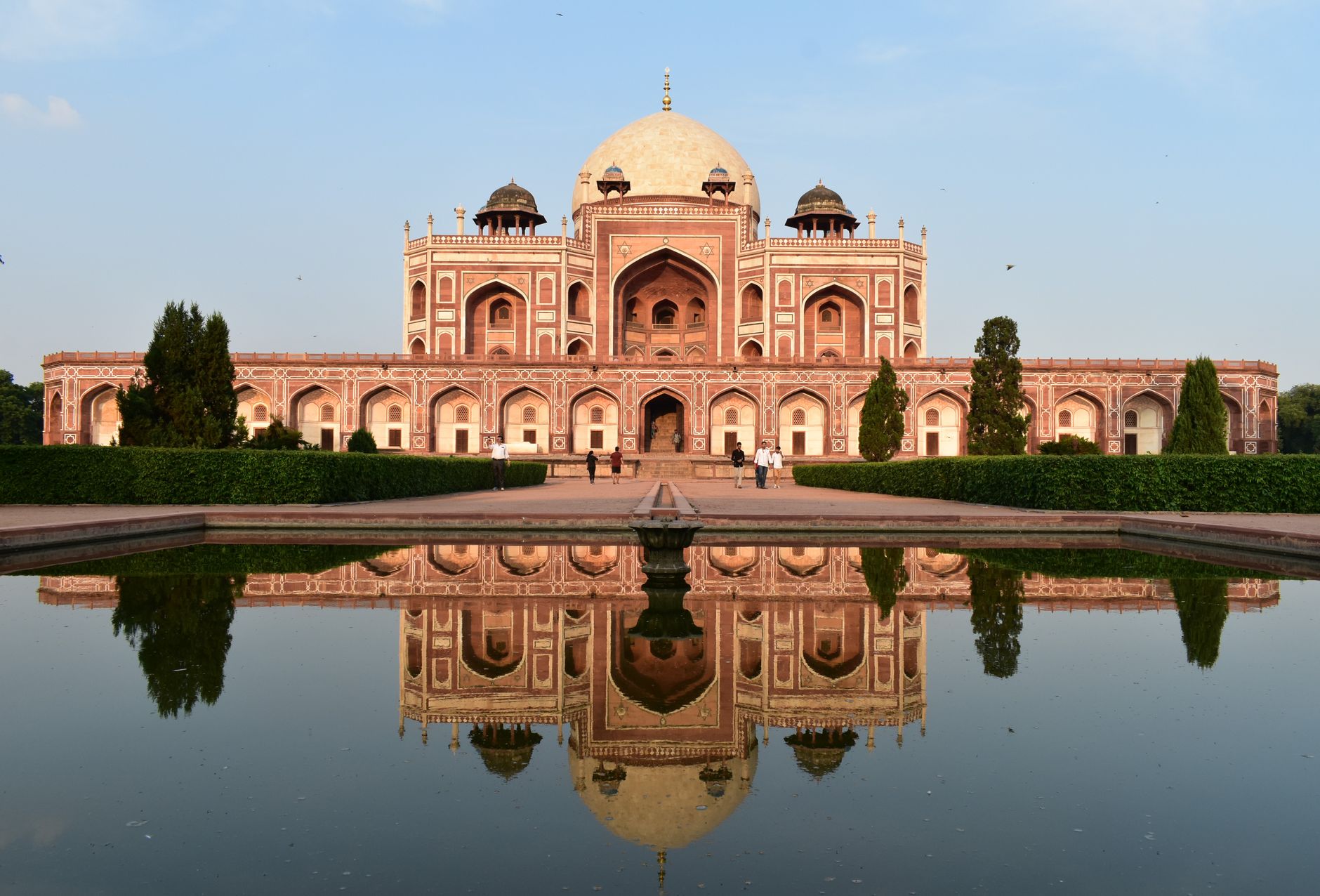
Humayun's Tomb was commissioned by Hamida Banu Begum, the second Mughal emperor's widow, and built between about 1565 and 1572 to a design by the Persian architect Mirak Mirza Ghiyas. It is the first structure in India to combine a monumental double dome, a red sandstone and white marble skin and a formal charbagh — a quartered garden divided by water channels into thirty-six squares. That template runs straight through Mughal architecture to Agra, and the tomb was inscribed by UNESCO in 1993. The platform stands roughly 47 metres high to the dome finial and hides more than a hundred graves in its vaulted chambers, which is why it is nicknamed the dormitory of the Mughals. A long restoration led by the Aga Khan Trust for Culture, completed in stages from 2003, stripped away twentieth-century concrete, relaid the water channels and reopened the garden much as it was intended.
The site is larger than the famous photograph. You enter through a west gate into a walled forecourt and the first monument you reach is not Humayun's at all: Isa Khan Niyazi's octagonal tomb and mosque of 1547, older than the emperor's, sunk in its own enclosure with a lovely glazed-tile parapet. Beyond it the path runs past Bu Halima's garden and Arab Serai gateway, then through the tall Bara Darwaza into the charbagh. Walk the raised causeway to the plinth, climb the steps on the south side, and inside you find a high, cool, almost bare octagonal chamber with a single cenotaph under a lattice of light from jali screens; the real grave lies below. Circle the terrace for the view over the garden, then walk out to the Barber's Tomb in the southeast quadrant and the blue-tiled Nila Gumbad beyond the east wall.
Give it two to three hours and treat it as a linked half-day with Sunder Nursery next door. Book the e-ticket in advance on the ASI portal; the QR lane at the west gate is fast, the cash counter is not. Wear shoes you can slip off at the tomb chamber threshold if asked, carry water, and use the shaded arcades of the Bara Darwaza in the middle of the day. The site interpretation centre near the entry, opened as part of the Nizamuddin renewal, is worth twenty minutes and is included. Skip the touts offering "skip-the-line" service — there is no line to skip. The one thing genuinely worth adding is a licensed guide, because the layout of the surrounding tombs is confusing and unlabelled in places.
By metro the closest useful stations are JLN Stadium and Jangpura on the Violet Line, each about 2 km away; from Rajiv Chowk allow 20 minutes and roughly ₹30, then an auto for ₹40-60. Khan Market on the same line is 3 km. Hazrat Nizamuddin railway station is 1.5 km south, a ₹40 auto ride, useful if you arrive on a train from Agra. By road the entrance is on Mathura Road, a straight run from India Gate in 12-15 minutes outside peak hours; the ASI car park inside the gate takes cars for around ₹20-30 and fills by mid-morning at weekends. Buses along Mathura Road stop at Nizamuddin. From Aerocity or the airport, a cab is 35-45 minutes depending on Ring Road traffic.
Entry costs ₹35 for Indian nationals and SAARC and BIMSTEC passport holders, ₹550 for other foreign nationals, with about ₹5 and ₹50 knocked off respectively for booking online. Under-15s are free. That single ticket covers the whole enclosure — Isa Khan's tomb, Bu Halima's garden, the Barber's Tomb and Humayun's own platform — so ignore anyone at the gate implying the outer tombs are separately charged. A video camera permit is ₹25. Sunder Nursery immediately north is a different property with its own gate and its own charge, so budget separately if you are combining them. Inside there is no café, only a water point and a small stall near the ticket office, so eat before or afterwards in Nizamuddin or Defence Colony.
The best hour is the first: at 06:00 in summer or 07:00 in winter the charbagh is empty, the light rakes across the sandstone and the parakeets are loud. Late afternoon from 16:30 gives the warmest colour on the west face and is the classic photographers' slot, but it is also the busiest. Midday between 12:00 and 15:00 means hard light, hot stone and coach groups. It opens every day, Mondays included. October to March is the good season, with cool mornings and clean light; December and January mornings can be foggy until 09:30. April to June is brutal on the treeless causeway, and the July-September monsoon leaves the lawns lush and the crowds thin, at the cost of humidity and sudden downpours with nowhere to shelter except the gateways.
It works well for most visitors. The main paths are broad and paved and the site is one of the more wheelchair-friendly ASI monuments in Delhi, though the tomb plinth itself is reached by a long flight of steps with no lift. Families find enough grass and shade for small children, and older children respond to the scale of the dome chamber. Wheelchair users, and anyone who cannot manage stairs, still get most of the value from the garden and Isa Khan's enclosure. On a very hot afternoon or in heavy rain there is limited cover and it becomes a slog. If you have only an hour between appointments it is still workable — the west gate to the plinth and back is about 40 minutes at a steady pace.
Nearby, Sunder Nursery is a five-minute walk north through the shared boundary and makes the obvious second half of the morning; Hazrat Nizamuddin Dargah is a 12-minute walk west through the basti lanes, best at dusk on a Thursday for qawwali; and Khan Market for lunch is a 10-minute drive. Honest caveats: the interior of the tomb chamber is austere and takes five minutes, so anyone expecting Taj Mahal-style inlay will be underwhelmed; the "first Mughal garden tomb" framing is true but the site is not laid out for a linear tour and it is easy to miss Nila Gumbad entirely; and the two-tier ticket price surprises foreign visitors. Weekend late afternoons are crowded enough to make the causeway photograph impossible.
Hours & entry
Not free
Daily 06:00-18:00 (sunrise to sunset) · Ticket counter closes 30 min before the gate · Open all week including Mondays
What to see
{'what': "Isa Khan Niyazi's octagonal tomb (1547)", 'where': 'First enclosure on the right, before the Bara Darwaza'}
{'what': 'The main cenotaph chamber', 'where': 'Centre of the raised plinth, up the south steps'}
{'what': "Nila Gumbad's blue tiled dome", 'where': 'Beyond the eastern wall, seen from the tomb terrace'}
Tips from the ground
Arrive at opening; the causeway shot is impossible after 16:00 at weekends.
One ticket covers Isa Khan's tomb and the Barber's Tomb — do not pay anyone extra at the inner gates.
Pair it with Sunder Nursery next door, which charges its own separate entry.
Questions, answered
What does Humayun's Tomb cost to enter?
₹35 for Indian nationals and SAARC or BIMSTEC citizens, ₹550 for other foreign nationals. Book on the ASI e-ticketing portal and it drops to roughly ₹30 and ₹500. Children under 15 enter free. That one ticket covers the entire walled complex, including Isa Khan's tomb, Bu Halima's garden and the Barber's Tomb. A video camera permit costs ₹25 extra. Sunder Nursery next door is a separate property with its own charge.
Is there a free entry window?
No. There is no free hour, free day or discounted evening at Humayun's Tomb; the ticket applies from opening to closing, every day of the year. Under-15s are the only routine exemption. The ASI has occasionally waived charges nationwide on World Heritage Day, 18 April, but the decision is announced only shortly beforehand and is not a reliable plan. Assume you will pay full price and buy online to save a little.
How long does a visit take?
Two to three hours for a proper look. A fast circuit — west gate, Bara Darwaza, plinth, cenotaph chamber and back — takes about 40 minutes. Two hours lets you add Isa Khan's enclosure, the Barber's Tomb, the terrace circuit and the interpretation centre. Three hours suits photographers or anyone continuing into Sunder Nursery afterwards. Allow another 20 minutes at each end for the auto ride from the Violet Line stations, which are about 2 km away.
What day is it closed?
It is not closed on any weekday. Humayun's Tomb opens daily from sunrise to sunset, around 06:00 to 18:00 in summer and 07:00 to 17:30 in winter, Mondays and public holidays included. The ticket counter shuts about 30 minutes before the gate. Short partial closures happen when conservation scaffolding goes up on a specific structure or during a state visit, and these are signposted at the west gate rather than published in advance.
Should I book tickets beforehand?
Booking is optional but sensible. E-tickets from the ASI portal are instant and the QR lane at the west gate usually clears in a couple of minutes, while the cash counter can back up for 10-15 minutes on Sunday afternoons. There is no timed entry and no daily cap, so tickets never run out. Licensed guides are hired at the gate, not booked online, and typically charge ₹500-900 for a small group.
Which metro station is nearest?
JLN Stadium and Jangpura on the Violet Line are both about 2 km from the gate; from Rajiv Chowk expect around 20 minutes and about ₹30, then a ₹40-60 auto. Khan Market station is 3 km and works if you are combining with lunch there. Hazrat Nizamuddin railway station lies 1.5 km south, handy if you arrive from Agra. By road the entrance is on Mathura Road, 12-15 minutes from India Gate off-peak.
Doing good is the business: every booking through Stay New Delhi funds one verified tonne of carbon removal — same room, same price, no markup.
Start Your Search