Jantar Mantar
Maharaja Jai Singh II's masonry observatory of 1724 — sundials the size of buildings, five minutes from Connaught Place.
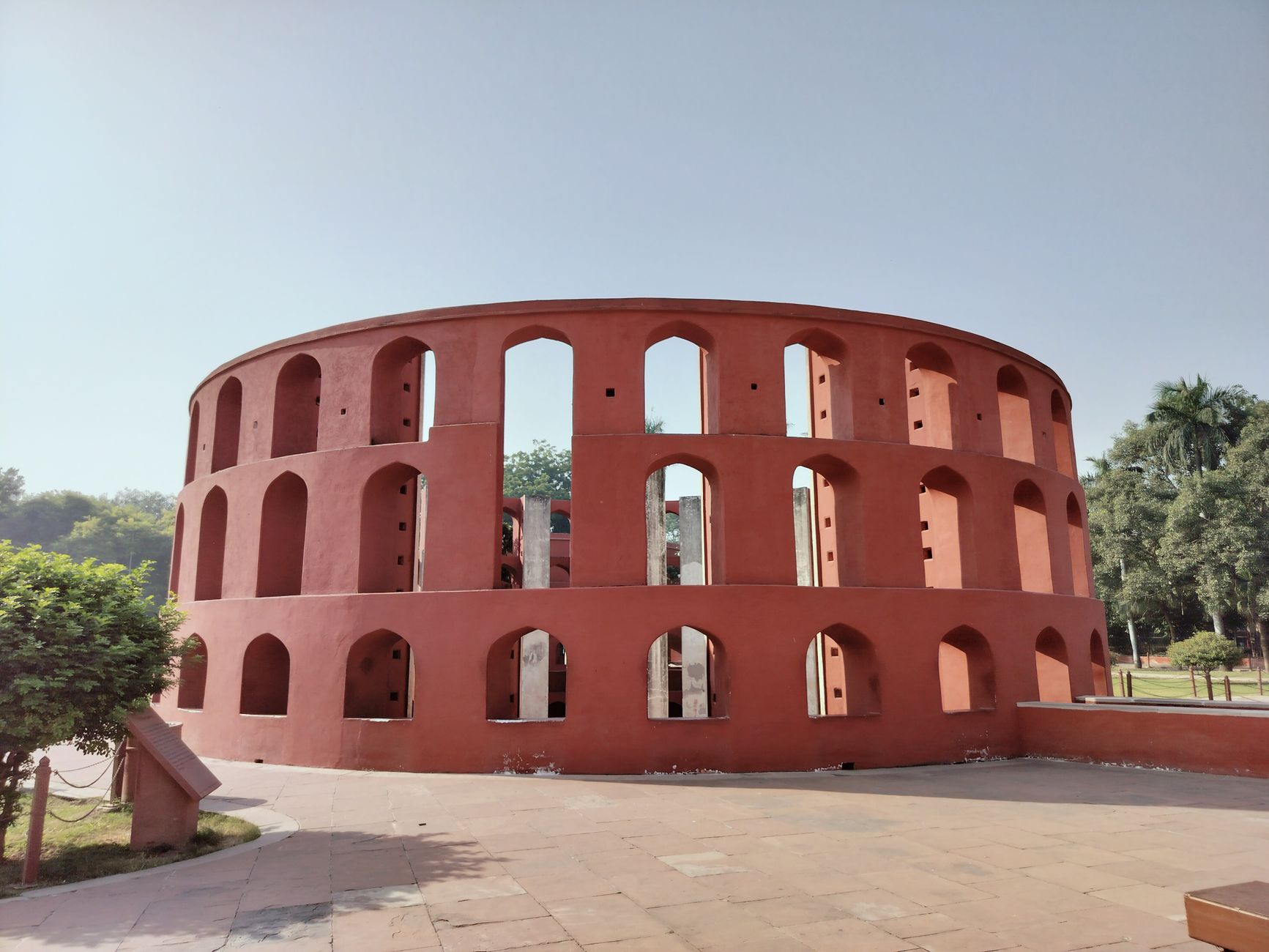
Jantar Mantar was built in 1724 by Sawai Jai Singh II of Amber, the astronomer-king who went on to build four more observatories, including the larger and better-preserved one at Jaipur. Commissioned to correct the astronomical tables then in use and to fix the calendar, the Delhi instruments are masonry rather than metal, built at enormous scale so that graduations could be read to a fine tolerance. Four principal instruments survive in a small walled garden off Sansad Marg: the Samrat Yantra, a giant right-angled triangle whose 27-metre hypotenuse is aligned to the pole and which functions as an equinoctial sundial; the Jai Prakash Yantra, two sunken hemispherical bowls marked with celestial coordinates; the Ram Yantra, a pair of open cylindrical structures for measuring altitude and azimuth; and the Misra Yantra, a composite instrument added later. They lost accuracy as buildings rose around them but remain the clearest surviving demonstration of pre-telescopic Indian astronomy.
The site is small and reading it is the whole point. From the gate the Samrat Yantra dominates: climb the steps beside the gnomon and you can see the curved quadrant scales on either side where the shadow falls, marked in hours and minutes. The Jai Prakash bowls are the most ingenious thing here — sunk into the ground in complementary halves so an observer can stand inside and read the position of the sun's image against marked lines. The Ram Yantra's twin open cylinders with radial walls come next, and the Misra Yantra, with its Niyat Chakra dials, stands near the western wall. Signboards explain each instrument reasonably well. The lawns are trim, the whole enclosure is about the size of two football pitches, and traffic noise from Sansad Marg is constant.
Forty-five minutes is honest; an hour if you read every board and wait for shadows to move. Come on a clear day, because the instruments do nothing at all under cloud and the site loses most of its interest in fog or rain. Mid-morning or mid-afternoon gives you long, legible shadows; noon is the least interesting because the gnomon shadow is shortest. Bring nothing; there is no cloakroom and no need. Guides occasionally wait at the gate and are worth ₹300-500 if you want the instruments demonstrated rather than described. Skip it entirely if you are also going to Jaipur, where the observatory is bigger, better preserved and a World Heritage Site in its own right.
This is the most central monument in Delhi. Patel Chowk on the Yellow Line is 600 metres north — walk down Sansad Marg for about eight minutes. Janpath on the Violet Line is 700 metres east. Rajiv Chowk, the Connaught Place interchange, is a 15-minute walk via the Outer Circle and Sansad Marg. From anywhere on the metro network expect ₹20-30 and under 25 minutes. Buses run along Sansad Marg and stop at Jantar Mantar. Parking is genuinely difficult: the roadside bays on Sansad Marg fill early and cost ₹20 an hour, and this stretch is also where protest gatherings are permitted, which periodically closes lanes. An auto from Paharganj is ₹80-100; from Karol Bagh ₹100-140.
Entry is ₹25 for Indian nationals and SAARC and BIMSTEC citizens and ₹300 for other foreign nationals, slightly cheaper on the ASI portal. Under-15s are free. A video camera permit is ₹25. There is no combined ticket with any other monument and nothing to buy inside beyond bottled water from a small stall near the gate. Given the size of the site, the foreign-national rate is the least favourable value-per-minute of any ASI monument in Delhi, which is worth knowing before you queue; if your time in the city is short, the same ₹300 goes much further at Purana Qila or Safdarjung's Tomb. For Indian visitors at ₹25 it is straightforwardly good value.
Go between 09:00 and 11:00 or between 15:00 and 17:00, when shadows are long and the instruments legible. It opens daily 09:00-18:00 including Mondays, so it fills gaps that the Red Fort cannot. Weekday mornings are quiet; weekend afternoons bring school groups who cluster at the Samrat Yantra steps. October to March is the good season, with clear skies and comfortable temperatures; December and January fog can leave the instruments useless before 10:00, which matters more here than anywhere else in the city. April to June is hot with no shade at all on the lawns. During the monsoon, cloud cover makes the sundials pointless for hours at a stretch.
It suits anyone with a scientific bent, school-age children who like puzzles, and travellers with a free hour in central Delhi. Paths are level and largely paved, so wheelchair users can reach and view every instrument, although the stairs up the Samrat Yantra gnomon are not accessible. Teenagers who respond to mechanics rather than architecture usually enjoy it more than they expect. It is a poor rainy-day option, because everything is outdoors and the instruments stop working. For a one-hour gap before a train from New Delhi station, which is 2.5 km north, it is one of the best choices in the city.
Everything in Connaught Place is walkable from here: the Inner and Outer Circle shops and restaurants are 10 minutes north, Janpath's market 8 minutes east, and Agrasen ki Baoli, a deep and free 14th-century stepwell tucked behind Hailey Road, is a 12-minute walk northeast and makes an excellent free pairing. The National Museum on Janpath is 2 km south. Honest caveats: it is small, and a visitor who does not read the signboards will be finished in fifteen minutes and feel short-changed at the foreign rate; the surrounding high-rises broke the instruments' sight lines long ago; Jaipur's Jantar Mantar is substantially more impressive; and the protest site on Jantar Mantar Road outside is a separate thing entirely, frequently confused with the monument.
Hours & entry
Not free
Daily 09:00-18:00 · Ticket counter closes 17:30 · Open Mondays and public holidays
What to see
{'what': 'Samrat Yantra equinoctial sundial', 'where': 'Dominating the centre of the enclosure, gnomon steps on the north side'}
{'what': 'Jai Prakash Yantra sunken bowls', 'where': 'Southeast quadrant, below ground level'}
{'what': 'Misra Yantra composite instrument', 'where': 'Against the western boundary wall'}
Tips from the ground
Come on a clear day and avoid noon — the instruments are dull when shadows are shortest.
Agrasen ki Baoli is a free 12-minute walk northeast and pairs well.
If Jaipur is on your itinerary, its observatory is larger and better preserved; you can skip this one.
Questions, answered
How much is entry to Jantar Mantar?
₹25 for Indian nationals and SAARC and BIMSTEC citizens, ₹300 for other foreign nationals, with a small discount on the ASI e-ticketing portal. Children under 15 are free. A video camera permit adds ₹25. There is no combined ticket with any other monument and nothing to buy inside except bottled water at the gate. Foreign visitors should note the site is small for the price; the same fee covers much larger monuments elsewhere in Delhi.
Are there free entry hours?
No. Jantar Mantar charges throughout its 09:00-18:00 opening, every day, with no free hour, free day or evening concession. Children under 15 are the only routine exemption. The lawns are visible in part from Sansad Marg through the railings if you only want a glimpse of the Samrat Yantra, but reading the instruments properly requires going in. If you want free astronomy-adjacent sightseeing nearby, Agrasen ki Baoli costs nothing.
How long does it take to see?
About 45 minutes. Fifteen minutes is enough to walk round the four instruments without reading anything, which is why some visitors feel short-changed. Forty-five minutes lets you read the signboards, climb the Samrat Yantra steps and watch the shadow move on the quadrant scales. An hour suits anyone with a guide or a genuine interest in the mathematics. It is the shortest major monument visit in central Delhi.
When is Jantar Mantar closed?
It is not closed on any weekday. Opening is daily 09:00 to 18:00, Mondays and public holidays included, with the ticket counter shutting around 17:30. That makes it a reliable Monday option alongside Qutub Minar and Humayun's Tomb. Occasional closures happen when large demonstrations are permitted on Jantar Mantar Road outside and access along Sansad Marg is restricted; those are decided on the day by the police.
Do I need to book ahead?
No. There is no timed entry, no capacity cap and rarely more than a couple of people at the counter, so walking up works any day. Buying an ASI e-ticket saves a few rupees and a minute, worth doing if you are already booking other monuments. Guides are hired informally at the gate for around ₹300-500 and cannot be pre-booked; if you want a proper astronomy explanation, arrange a specialist walk in advance.
Which metro station is nearest?
Patel Chowk on the Yellow Line, 600 metres north — about eight minutes down Sansad Marg. Janpath on the Violet Line is 700 metres east, and Rajiv Chowk in Connaught Place is a 15-minute walk. From anywhere on the network expect ₹20-30 and under 25 minutes. Buses stop on Sansad Marg outside. Parking is scarce and the roadside bays cost about ₹20 an hour, so the metro is much the better plan.
Doing good is the business: every booking through Stay New Delhi funds one verified tonne of carbon removal — same room, same price, no markup.
Start Your Search