Mehrauli Archaeological Park
Around a hundred monuments spread over two hundred acres of scrub and old woodland, free to walk, and the only place in Delhi where a thousand years of building sit within one boundary wall.
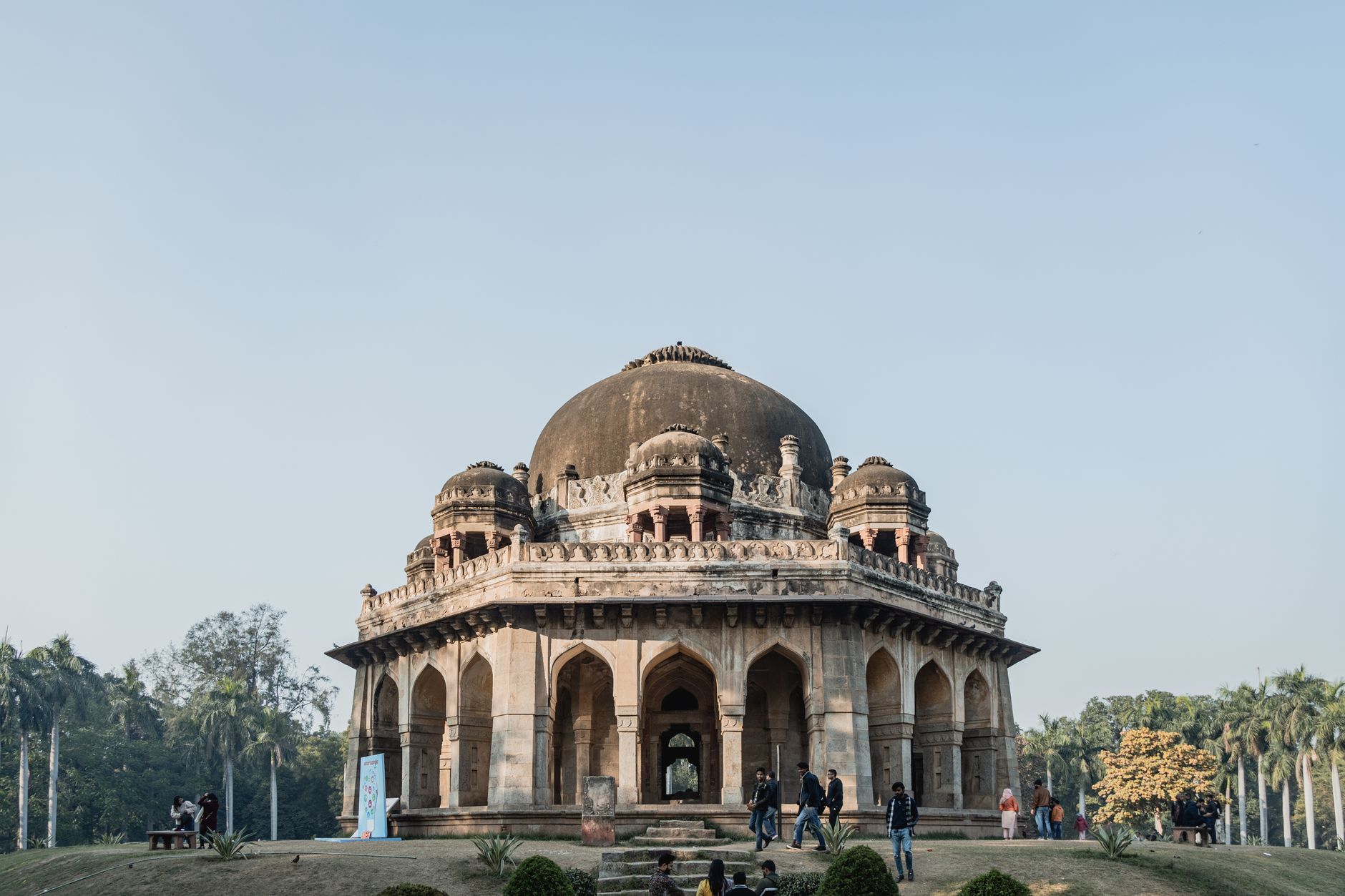
Mehrauli Archaeological Park covers roughly 200 acres immediately south and east of the Qutub complex and contains something like a hundred structures spanning a thousand years, from Delhi Sultanate tombs to late Mughal pavilions and British colonial follies. The headline monuments are Balban's tomb, from around 1287, whose ruined chamber contains what is often described as the earliest true arch in India; the Jamali Kamali mosque and tomb of 1528-29, the tomb chamber painted and tiled in blue and red; Rajon ki Baoli, a deep stepwell of about 1506; Gandhak ki Baoli, an earlier stepwell from Iltutmish's reign; the tomb of Quli Khan, converted into a country retreat called Dilkusha by the British Resident Thomas Metcalfe in the 1840s; and Metcalfe's own follies scattered across the ridge. Unlike the ticketed monuments around it, the park is unfenced in places and free to enter.
Walking it is the point. Paths wind through kikar and neem woodland between ruins that arrive without warning — a domed tomb here, a boundary wall there, a colonial boathouse beside a dry tank. Start at the gate opposite the Qutub Minar car park, and the first cluster brings you to Balban's tomb and the adjacent Khan Shahid's tomb within ten minutes. Jamali Kamali sits a few hundred metres on, its mosque courtyard restored and its tomb chamber usually locked but opened by the caretaker if you ask. Rajon ki Baoli is the most photogenic single object in the park: four tiers of arcaded galleries descending to green water, with a small mosque and tomb on the platform above. Further east, Metcalfe's Dilkusha and the folly he built as a ziggurat sit half-swallowed by trees.
Give it two to three hours, more if you like maps. The park is poorly signposted, paths fork constantly and phone GPS is genuinely useful; download the area offline before you go. Wear closed shoes for thorn scrub and take water, because there is nothing to buy inside. Morning is far better than afternoon, both for light and because the woodland is quiet. Guided heritage walks run here regularly from Delhi walking-tour operators and are worth the money if you want the monuments identified. Skip the far eastern sections in high grass after monsoon rain. Do not plan on the Jamali Kamali interior being open — treat it as a bonus if the caretaker is around.
The nearest metro is Qutab Minar on the Yellow Line, about 2 km north; from Rajiv Chowk that is roughly 30 minutes and about ₹40, then a ₹30-50 auto to the park gate on Anuvrat Marg opposite the Qutub complex. Saket station is a similar distance east. Buses 715 and 505 run down Mehrauli-Badarpur Road and stop at Qutub Minar or Mehrauli terminal, from which the park entrance is a 10-minute walk. By car, use the Qutub Minar ASI car park at about ₹20-30 and cross the road on foot; parking inside Mehrauli village is very tight. From Aerocity a cab takes 25-30 minutes. There are several informal entrances around the perimeter, including one from Mehrauli village near Zafar Mahal.
There is no entry charge at any gate, at any hour, for anyone — this is one of the few major heritage sites in Delhi that costs nothing. That also means no ticket counter, no cloakroom, no formal guides and no toilets except in Mehrauli village outside the boundary. Budget instead for the extras: an auto from the metro at ₹30-50 each way, water and snacks bought before you enter, and ₹500-1,500 per head if you join an organised heritage walk. If you are combining the park with the Qutub Minar complex across the road, that is a separate ₹35 or ₹550 ticket. Photography, including tripods, is unrestricted here, which makes it a favourite with photographers priced out of the ASI video permits elsewhere.
Come between 07:00 and 10:00. The light through the woodland is best then, the temperature is bearable and you will meet dog-walkers and joggers rather than nobody at all. Late afternoon light on Rajon ki Baoli is good but the park empties fast towards dusk and you do not want to be finding your way out in the dark. It is open every day. October to March is the season, and February is arguably the single best month, with flowering trees and clear air. December fog can make the eastern paths disorienting before 09:30. April to June is hot and dusty with limited shade on the open stretches; the monsoon brings deep green, mosquitoes, snakes in long grass and slippery stepwell edges.
It suits walkers, photographers and anyone who has done the ticketed monuments and wants something less managed. It is not wheelchair accessible in any meaningful way — the paths are earth, roots and rubble. Families with small children will find the stepwell edges genuinely unguarded, which is worth taking seriously. Teenagers who like exploring do very well here. On a rainy day it is a washout, and for a one-hour gap it barely gets you past Balban's tomb. Solo visitors should stay on the main paths and go in the morning, as the park is large, lightly used mid-week and only informally patrolled.
Fold it into a Mehrauli half-day. The Qutub Minar complex gate is directly across the road, ten minutes on foot; Mehrauli village bazaar and Zafar Mahal, the last Mughal palace gateway, are 15 minutes east through the lanes; and the Saket malls are 4 km northeast if you want lunch and air conditioning afterwards. Honest caveats: many monuments are unlabelled and you will walk past things without knowing what they were; several structures are locked or fenced; the park is used as a shortcut and a picnic spot and litter is a real problem in the accessible corners; and the frequently repeated claim that you can see a hundred monuments is technically true but practically means a lot of anonymous walls. Come for the walk as much as the buildings.
Hours & entry
Open access, no entry charge at any time
Daily sunrise to sunset, roughly 06:00-18:30 · Jamali Kamali tomb interior opens irregularly, usually 09:00-17:00 · No ticket counter
What to see
{'what': 'Rajon ki Baoli stepwell', 'where': 'Northern section, about 400 m east of the Qutub-side gate'}
{'what': 'Jamali Kamali mosque and tomb', 'where': "Central clearing, south of Balban's tomb"}
{'what': "Balban's tomb and its early true arch", 'where': 'First ruin cluster inside the northern entrance'}
Tips from the ground
Download an offline map — paths fork constantly and signage is minimal.
Ask the caretaker at Jamali Kamali about the painted tomb chamber; it is often locked but sometimes opened.
Free entry and no camera permits, so this is the tripod-friendly alternative to the Qutub complex opposite.
Questions, answered
Does Mehrauli Archaeological Park charge entry?
No. The park is free to enter at every gate and at every hour, with no ticket counter anywhere on the site. That also means no camera permit and no tripod fee, unlike the ASI ticketed monuments nearby. Your only costs are transport — around ₹30-50 for an auto from Qutab Minar metro — and water and snacks, which you must bring in. If you cross to the Qutub Minar complex opposite, that is a separate ₹35 or ₹550 ticket.
When is it free to visit?
At all times it is open, which is sunrise to sunset, seven days a week. There is no charging window at all and no concession structure, because there is no ticket. The practical limit is daylight: gates and informal entrances are unstaffed after dark and the wooded paths are unlit, so plan to be out by sunset. Organised heritage walks charge their own fee, typically ₹500-1,500 per person, but you can walk the park independently for nothing.
How long is a visit?
Two to three hours for a proper circuit. An hour gets you Balban's tomb, Jamali Kamali and Rajon ki Baoli, which is the essential trio. Two hours adds Gandhak ki Baoli, Quli Khan's tomb and the Metcalfe follies. Three hours is right if you are photographing or joining a guided walk. Because it adjoins the Qutub complex, most people combine the two into a four- to five-hour Mehrauli half-day starting at opening.
Is the park closed on any day?
No. It is open daily, sunrise to sunset, including Mondays and public holidays, and there is no gate to shut in several places. Individual monuments within it may be locked — the Jamali Kamali tomb chamber in particular is opened at the caretaker's discretion — and sections are occasionally fenced during conservation work. After heavy monsoon rain the eastern paths can be waterlogged and the stepwell steps slippery and best avoided.
Do I need to book anything?
No booking exists for the park itself; you simply walk in. The only thing worth booking is a guided heritage walk, which several Delhi operators run at weekends and which is genuinely useful given how little is signposted; those need a day or two of notice and cost roughly ₹500-1,500 per head. If you plan to see the Qutub Minar complex the same morning, book that ASI e-ticket separately to skip the cash queue.
What is the nearest metro station?
Qutab Minar on the Yellow Line, about 2 km north of the main entrance, roughly 30 minutes and ₹40 from Rajiv Chowk, then a ₹30-50 auto to the gate on Anuvrat Marg opposite the Qutub complex. Saket station on the same line is a similar distance from the eastern side. Buses 715 and 505 stop at Qutub Minar or Mehrauli terminal, both within a 10-minute walk of a park entrance.
Doing good is the business: every booking through Stay New Delhi funds one verified tonne of carbon removal — same room, same price, no markup.
Start Your Search