Red Fort (Lal Qila)
Shah Jahan's walled Mughal capital, the stage for the Independence Day address, and the only place in Delhi where you can walk from a covered bazaar into an emperor's marble audience hall in ten minutes.
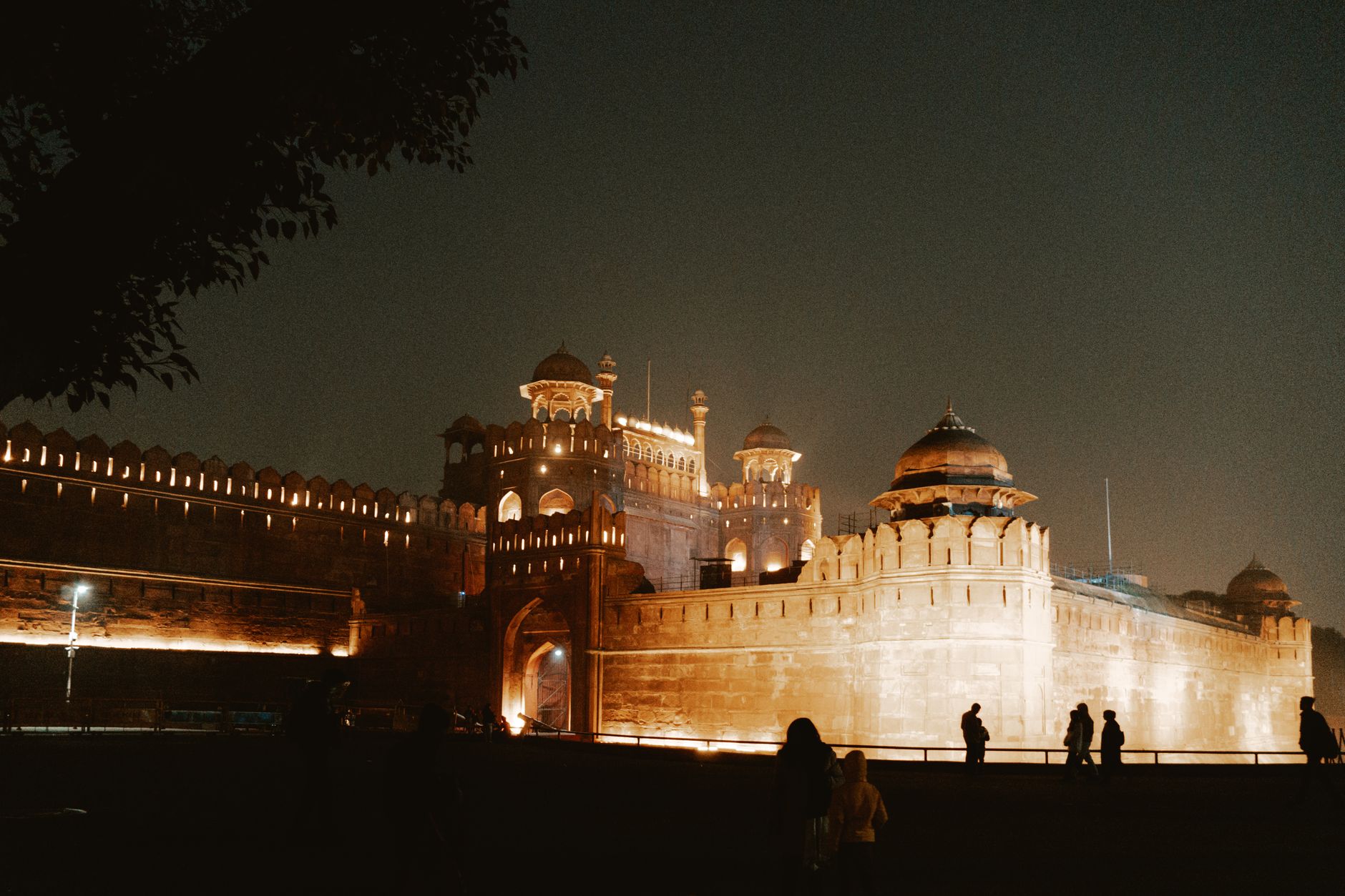
The Red Fort was built between 1638 and 1648 when Shah Jahan moved the Mughal capital from Agra to his new city of Shahjahanabad. Its sandstone curtain wall runs roughly 2.4 km with bastions rising as high as 33 metres on the city side, enclosing about 254 acres. Inside stood a court complex of marble halls, gardens and water channels — the Nahr-i-Bihisht, or Stream of Paradise, once ran through the private apartments. The fort was looted by Nadir Shah in 1739, stripped further after 1857 when the British demolished much of the residential quarter for barracks, and became the site from which the Prime Minister addresses the nation each 15 August. UNESCO inscribed it in 2007. What survives is fragmentary, but the surviving fragments — Diwan-i-Aam, Diwan-i-Khas, Rang Mahal, the hammam, Moti Masjid — are the finest late-Mughal work in the city.
You enter at the Lahori Gate after a security check and walk straight into Chatta Chowk, a vaulted arcade of shops that was once the imperial bazaar and now sells souvenirs and marble trinkets. Past the Naubat Khana, the drum house where musicians announced arrivals, a lawn opens onto the Diwan-i-Aam, the hall of public audience, with its inlaid marble canopy where the emperor sat. Beyond it, along the eastern rampart, run the private pavilions: Rang Mahal with its lotus-shaped water basin, Khas Mahal, the Diwan-i-Khas with the Persian couplet about paradise on earth, the marble hammam, and Aurangzeb's small Moti Masjid of 1659. The Hayat Bakhsh Bagh garden lies at the north end. Two museums, on 1857 and on the Indian National Army, occupy the barracks and are covered by the same ticket.
Two to three hours is enough, and the entry gate matters. Everyone goes in through the Lahori Gate on Netaji Subhash Marg; the Delhi Gate on the south side is used only for events. Book the e-ticket, keep bags small because there are strict security checks and no proper cloakroom, and be aware that lighters, drones and large tripods will be confiscated. Wear shoes you can walk in — the distance from the gate to the Moti Masjid and back is well over a kilometre on hard paving. Skip the marble-inlay showrooms in Chatta Chowk unless you want to shop. In the fortnight around Independence Day the fort closes or restricts access for rehearsals and security; check before travelling in early to mid-August.
The Violet Line runs to Lal Qila station, whose exit puts you about 300 metres from the ticket area — this is the simplest approach. From Rajiv Chowk change at Kashmere Gate or ride the Yellow Line to Chandni Chowk station instead, which is 1 km west and a good option if you want to walk the bazaar first; the ride is 10-12 minutes and about ₹20-30. A cycle rickshaw from Chandni Chowk metro to the Lahori Gate costs ₹40-60 and is genuinely faster than a car in that traffic. Driving is a poor idea: the parking on Netaji Subhash Marg is limited and the surrounding streets are jammed from mid-morning. From Aerocity or the airport allow 45-60 minutes by cab. Auto from Connaught Place is around ₹90-120.
The ticket is ₹35 for Indian nationals and SAARC and BIMSTEC citizens and ₹550 for other foreign nationals, reduced by about ₹5 and ₹50 when bought on the ASI portal. Children under 15 are free. The price includes the museums inside the barracks, so do not buy separate museum tickets from anyone offering them. A video camera permit is ₹25. The evening sound and light show is a separate ticket, generally in the ₹80-250 band depending on seating and language, and is bought at the counter near the Delhi Gate side; it is often cancelled in rain and in high summer. Inside the fort there are drink kiosks and a snack stall near the Naubat Khana at tourist prices; nothing else is charged.
Open Tuesday to Sunday 09:30-16:30 and closed all day Monday — the single most common wasted trip in Delhi. Arrive at 09:30 and you get Chatta Chowk and the Diwan-i-Aam nearly empty for half an hour; by 11:30 school groups fill the lawns and the security queue at Lahori Gate can run 20-30 minutes on a Sunday. Late afternoon is calmer again but the light on the western wall goes flat and you are pushed out at 16:30. October to March is the season; winter mornings are foggy and the sandstone looks grey until the sun burns through around 10:00. April to June is punishing, with almost no shade on the long central axis. During the monsoon the lawns green up and the crowd thins, but sudden downpours leave you sheltering in the Naubat Khana.
Families do fine — there is space to walk, the museums give a break from the sun, and the scale impresses children. Wheelchair users can manage the main axis from Lahori Gate to the Diwan-i-Aam on paved routes, but several pavilions have stepped plinths and the barracks museums are not fully accessible. Teenagers tend to engage more with the 1857 and INA museums than with empty marble halls. It is a poor choice on a wet afternoon and a poor choice for a one-hour gap, because the security queue alone can eat that hour. Anyone expecting furnished palace rooms should recalibrate: the interiors were stripped long ago and what you are looking at is architecture, not contents.
Everything else in Old Delhi is on foot from here. The Jama Masjid is a 12-minute walk southwest through Meena Bazaar; Chandni Chowk's main street starts directly opposite the fort and runs a kilometre west past the Sisganj Gurudwara and the spice lanes of Khari Baoli; Paranthe Wali Gali is about 15 minutes on foot. Honest caveats: a good third of the original palace complex no longer exists, and the British-era barracks that replaced it dominate the middle of the site; Chatta Chowk is a tourist bazaar, not a Mughal market experience; the sound and light show is dated and frequently cancelled; and the Monday closure combined with the August security shutdown catches out more visitors here than at any other Delhi monument.
Hours & entry
Not free
Tue-Sun 09:30-16:30 · Closed Mondays · Sound and light show most evenings, weather permitting
What to see
{'what': 'Diwan-i-Khas and its inlaid marble piers', 'where': 'Eastern rampart, north of Rang Mahal'}
{'what': 'Chatta Chowk vaulted bazaar', 'where': 'Immediately inside the Lahori Gate'}
{'what': 'Moti Masjid (1659)', 'where': 'West of the hammam, near the north end of the palace line'}
Tips from the ground
Never come on a Monday — it is shut all day, unlike Qutub Minar and Humayun's Tomb.
Carry the smallest bag you can; security is strict and there is no real cloakroom.
Check access in the fortnight around 15 August, when Independence Day rehearsals close the fort.
Questions, answered
How much is a Red Fort ticket?
₹35 for Indian nationals and SAARC and BIMSTEC passport holders, ₹550 for other foreign nationals, with about ₹5 and ₹50 off if you book on the ASI e-ticketing portal. Under-15s enter free. The ticket includes the museums housed in the barracks, so refuse any separate museum charge. Video camera permits are ₹25. The evening sound and light show is ticketed separately, usually ₹80-250 depending on seat and language.
Are there free entry times?
No. The Red Fort charges throughout its Tuesday-to-Sunday opening hours, with no free evening, no free Sunday and no monthly free day. Children under 15 are the only standard exemption. National-holiday access is not free either; on the contrary, around 15 August the fort is closed or heavily restricted for Independence Day rehearsals and security. Plan on paying the full published rate and buy online to save the small booking discount.
How long do I need inside?
Two to three hours. Ninety minutes covers Chatta Chowk, the Naubat Khana, the Diwan-i-Aam and the main pavilion line along the eastern wall. Two and a half hours adds the Moti Masjid, Hayat Bakhsh Bagh and one of the barracks museums. Three hours suits anyone reading the museum displays properly. Add 20-30 minutes for the security queue at Lahori Gate on Sundays and public holidays, when it is at its worst.
When is the Red Fort closed?
Every Monday, all day. It opens Tuesday to Sunday from 09:30 to 16:30, with the ticket counter closing around 16:00. It also closes or restricts entry for several days around 15 August for Independence Day preparations and the ceremony itself, and occasionally for state functions. If your Delhi day is a Monday, switch to Qutub Minar, Humayun's Tomb or Jama Masjid, all of which open seven days a week.
Do I need to book in advance?
Not mandatory, but the e-ticket saves real time here. The QR lane at Lahori Gate moves faster than the cash window, which can back up badly on weekend mornings, and you still have the separate security screening to clear afterwards. There is no capacity limit or timed slot, so tickets do not sell out. Book the sound and light show at the counter on the day; it is regularly cancelled in rain, so do not prepay far ahead.
What is the nearest metro?
Lal Qila station on the Violet Line, whose exit is roughly 300 metres from the ticket area — the shortest walk of any option. Chandni Chowk station on the Yellow Line is 1 km west and better if you want to walk the bazaar first; a cycle rickshaw from there costs ₹40-60 and beats a car through that traffic. From Rajiv Chowk allow 10-15 minutes and around ₹20-30. Driving is not recommended; parking nearby is minimal.
Doing good is the business: every booking through Stay New Delhi funds one verified tonne of carbon removal — same room, same price, no markup.
Start Your Search