Safdarjung's Tomb
The last great garden-tomb of the Mughal era, built in 1754 from stone reportedly stripped off an earlier tomb, and the quietest monument of its size in central Delhi.
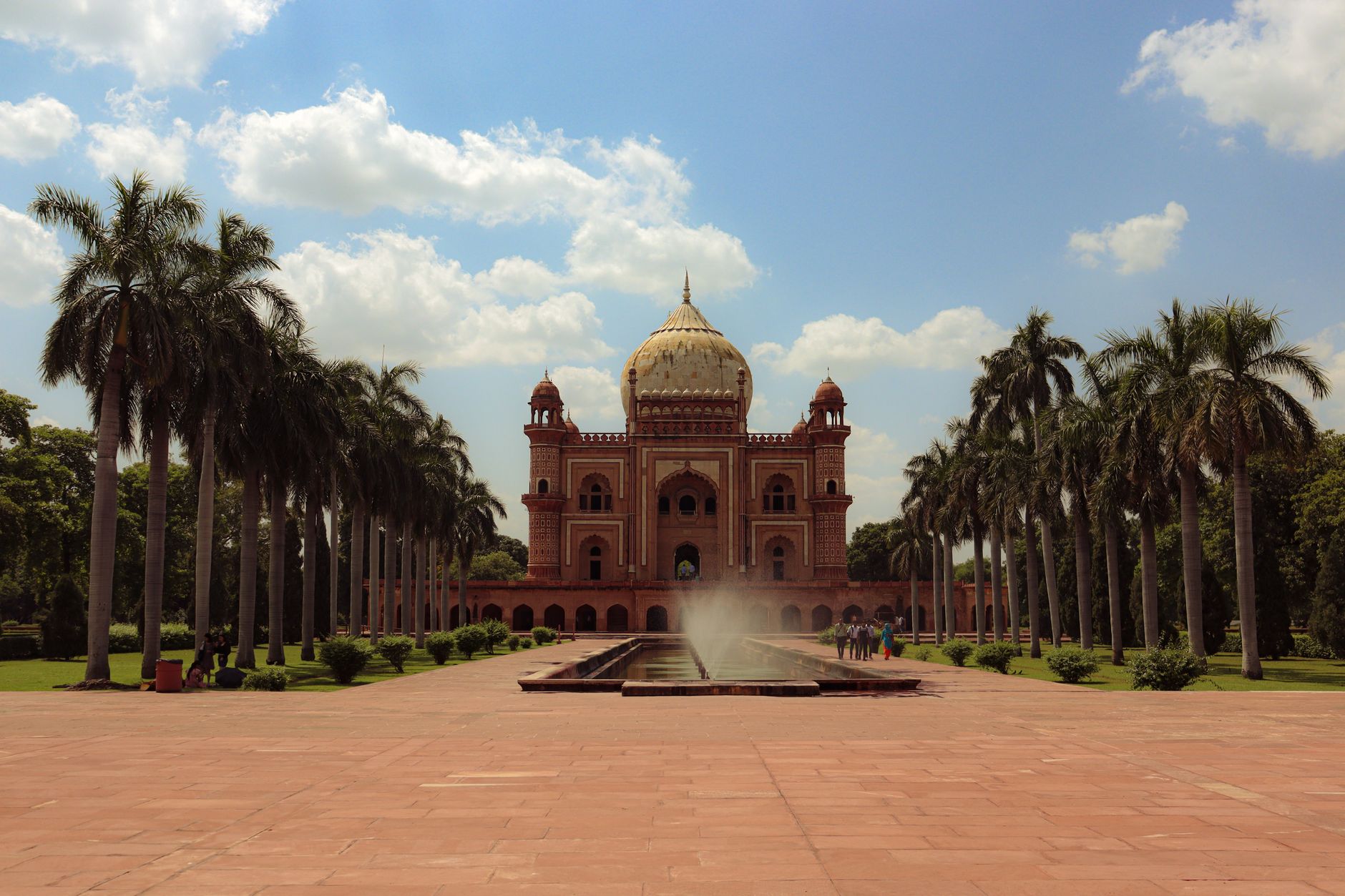
Safdarjung's Tomb was raised in 1753-54 for Mirza Muqim Abul Mansur Khan, titled Safdarjung, Nawab of Awadh and prime minister to the Mughal emperor Ahmad Shah Bahadur, by his son Nawab Shujaud Daula. It is the last monumental garden-tomb of the Mughal tradition and is usually described, after the historian Percival Spear, as the last flicker in the lamp of Mughal architecture. The design copies Humayun's Tomb at reduced scale and with a taller, more bulbous dome; the marble is said to have been taken from the earlier tomb of Abdur Rahim Khan-i-Khanan at Nizamuddin. The tomb stands on a terrace in the centre of a walled charbagh about 280 metres square, entered through a two-storey gateway, with pavilions named Jangli Mahal, Moti Mahal and Badshah Pasand set into the enclosure walls and a madrasa behind the gate.
It is a calm, self-contained visit. Through the gateway, the garden opens with water channels running to the four sides and the tomb ahead on its plinth. Climb the steps to the terrace and enter the central chamber: an octagonal space with a cenotaph under the dome, and the real grave in a crypt below reached by a side stair. Corridors run round the chamber, connecting the corner rooms, and the whole thing feels much airier than Humayun's tomb. Outside, walk the terrace edge for views back down the axis to the gate, then follow the enclosure walls to the pavilions, which are usually locked but attractive from outside. The lawns are well kept and largely empty on a weekday, and parakeets and hoopoes are common in the older trees.
An hour to ninety minutes is plenty. There is no queue and rarely a guide, so this is a good place to visit without any preparation, though the ASI signboard by the gate is minimal and reading a paragraph beforehand helps. Come early or late for the light; the dome faces the sun squarely at midday and photographs flatly. Bring water — there is a tap but no kiosk inside. This pairs naturally with Lodhi Garden, whose western gate is about a kilometre east, and with Khan Market for lunch. Skip it if you have already seen Humayun's Tomb the same day and are short of time; the family resemblance is strong enough that the second visit adds less.
Jor Bagh station on the Yellow Line is 700 metres from the gate, which makes this the easiest major monument in Delhi to reach on foot from a metro exit — turn right out of the station and walk up Aurobindo Marg for about nine minutes. From Rajiv Chowk the ride is about 12 minutes and ₹30. The tomb sits at the junction of Lodhi Road and Aurobindo Marg, so buses along both roads stop within 200 metres. By car there is a small ASI parking bay at the gate for around ₹20-30, but the junction is one of the busiest in central Delhi and the turn is awkward; an auto from Connaught Place costs ₹80-120 and takes 20 minutes. From Aerocity a cab is 25-35 minutes via Ring Road.
Entry is ₹25 for Indian nationals and SAARC and BIMSTEC citizens, and ₹300 for other foreign nationals, with a small saving for booking on the ASI e-ticketing portal. Children under 15 are free. That covers the garden, the tomb chamber, the crypt stair and the terrace. Video camera permits cost ₹25; phones and still cameras are free. There is nothing to buy inside — no café, no shop, no audio guide — so the ticket is the whole cost apart from parking. Lodhi Garden, a kilometre east, is free if you want to extend the walk without spending more, and Khan Market's restaurants two kilometres northeast are where the money actually goes on this half-day.
The tomb is at its best in the first hour after opening at 07:00, when the garden is misty in winter and the low sun catches the eastern face, and again after 16:00 when the dome turns cream-gold. Midday is bright and empty and perfectly fine if you are passing. This is one of the least crowded major monuments in the city: even on a Sunday afternoon you will share the garden with a few dozen people rather than a few thousand. It opens every day, Mondays included. Winter, November to February, is the best season, with morning fog burning off around 09:30. April to June is hot on the open terrace, and the monsoon leaves the lawns green and the marble streaked.
It suits anyone who wants a Mughal garden-tomb without the crowds — photographers, couples, readers, and visitors staying in Chanakyapuri, Lodhi Colony or Jor Bagh who can walk here. Wheelchair users can enjoy the garden and the axis view, but the tomb terrace is reached by a substantial flight of steps with no ramp. Families find enough lawn for small children, though there is little shade in the middle of the garden. For a one-hour gap before a train from Nizamuddin or an appointment on Lodhi Road it is close to perfect, given the seven-minute walk from Jor Bagh station.
Fold it into central Delhi's most walkable half-day: Lodhi Garden's western gate is a 15-minute walk east along Lodhi Road, with its Sultanate tombs free to visit; Khan Market for lunch is 20 minutes on foot or five by auto; the National Museum on Janpath is 4 km north. Honest caveats: the interior is bare, and visitors expecting inlay or decoration on the scale of Agra will find plain plaster and a single cenotaph; the pavilions in the enclosure walls are almost always locked; the road junction outside is loud enough to be audible in the garden; and the much-quoted story about the marble being looted from Khan-i-Khanan's tomb is likely but not documented as fact. Come for the garden and the quiet.
Hours & entry
Not free
Daily 07:00-17:00 · Ticket counter closes 16:30 · Open Mondays and public holidays
What to see
{'what': 'Central cenotaph chamber under the dome', 'where': 'Top of the terrace steps, on the main axis'}
{'what': 'Crypt with the actual grave', 'where': 'Side stair off the ambulatory corridor'}
{'what': 'Two-storey entrance gateway and madrasa', 'where': 'Eastern boundary, above the ticket gate'}
Tips from the ground
Jor Bagh metro is a nine-minute walk — leave the car at the hotel.
Go at 07:00 or after 16:00; midday light flattens the dome completely.
Walk on to Lodhi Garden afterwards, 15 minutes east and free.
Questions, answered
What does Safdarjung's Tomb cost?
₹25 for Indian nationals and SAARC and BIMSTEC citizens, ₹300 for other foreign nationals, marginally less if bought on the ASI e-ticketing portal. Children under 15 enter free. The ticket covers the garden, the terrace, the tomb chamber and the crypt stair, which is everything open to visitors. A video camera permit is ₹25; phones and still cameras are included. There is no café or shop inside, so the ticket plus perhaps ₹20-30 parking is your whole cost.
Is there ever free entry?
No. The charge applies during all opening hours, every day, with no free window, no free Sunday and no evening concession. Under-15s are the only routine exemption. The ASI has occasionally waived entry across ticketed monuments on World Heritage Day, 18 April, but that is decided at short notice. If you want a free garden-tomb experience the same afternoon, Lodhi Garden a kilometre east has Sultanate tombs and costs nothing.
How long should a visit take?
One to two hours, and 45 minutes is enough if you are passing. Half an hour covers the gateway, the axis walk, the tomb chamber and the terrace. An hour lets you circle the enclosure walls and look at the pavilions from outside. Ninety minutes suits photographers waiting for the light. Since Jor Bagh metro is only a seven-to-nine minute walk away, the door-to-door commitment is far smaller than at Qutub or Tughlaqabad.
Which day is it closed?
None. Safdarjung's Tomb opens seven days a week from 07:00 to 17:00, including Mondays and public holidays, with the ticket counter closing about 16:30. This makes it a useful Monday alternative when the Red Fort is shut. Wall pavilions such as Jangli Mahal and Moti Mahal are usually kept locked regardless of the day, and occasional conservation work can fence off part of the terrace, signposted at the gate.
Do I need to book in advance?
No. This is among the quietest major monuments in Delhi and there is essentially never a queue; walking up and paying at the counter takes a minute or two. An ASI e-ticket is convenient if you are already buying one for Humayun's Tomb or Qutub Minar on the same day, and saves a few rupees. No timed slots, no daily cap and no guide booking system operate here, so nothing sells out.
What is the nearest metro station?
Jor Bagh on the Yellow Line, 700 metres from the gate — turn right out of the station and walk about nine minutes up Aurobindo Marg. From Rajiv Chowk that is roughly 12 minutes and ₹30. Buses along Lodhi Road and Aurobindo Marg stop within 200 metres. There is a small ASI parking bay at the entrance for ₹20-30, but the junction is heavily trafficked and the metro is genuinely the better option.
Doing good is the business: every booking through Stay New Delhi funds one verified tonne of carbon removal — same room, same price, no markup.
Start Your Search