Sunder Nursery (Azim Bagh)
Ninety acres of restored Mughal garden, arboretum and wetland wrapped around fifteen sixteenth-century monuments — the calmest big green space in central Delhi and the one park worth paying to enter.
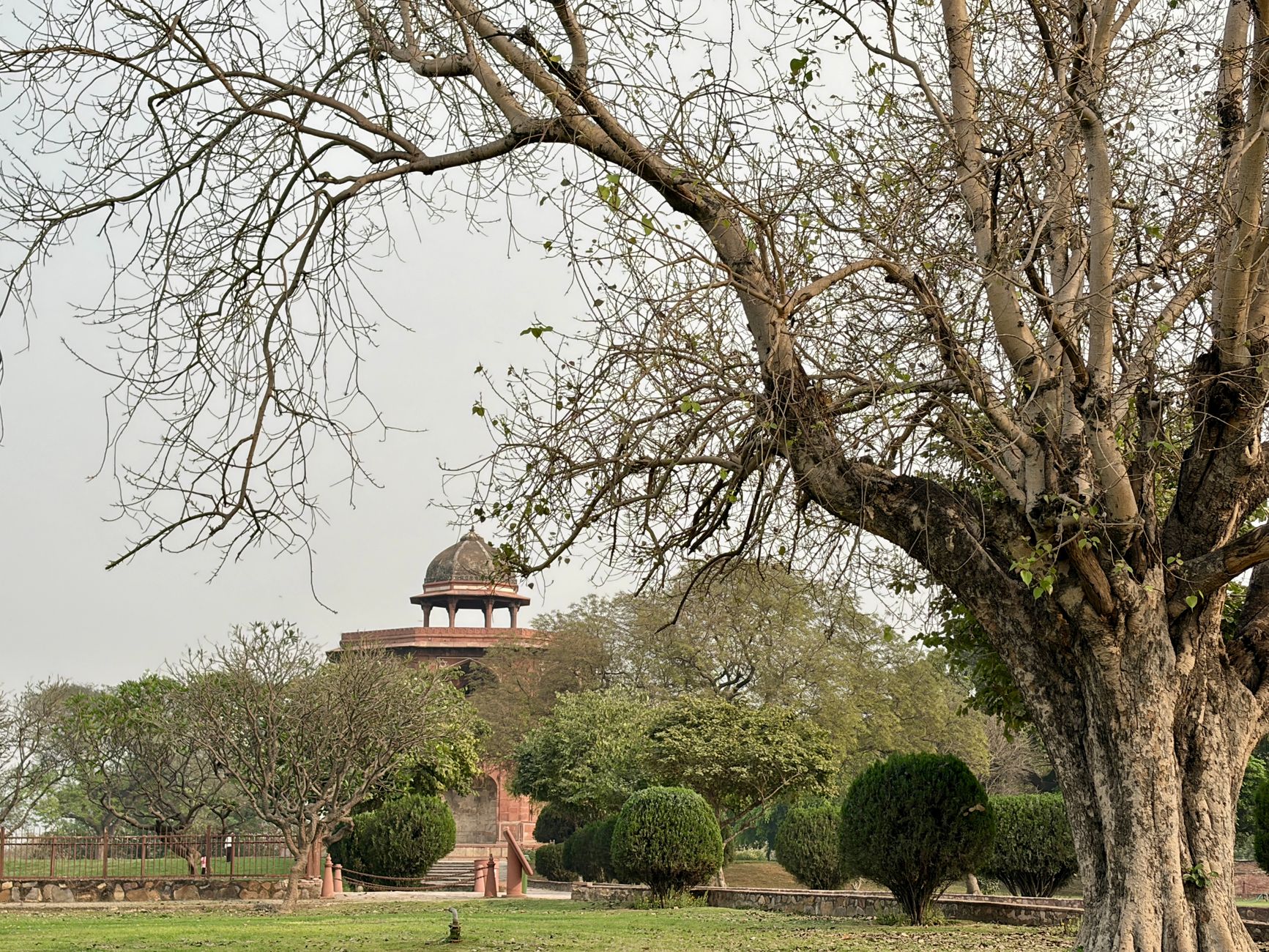
Sunder Nursery is the largest heritage park laid out in India in more than a century: roughly ninety acres of restored Mughal garden, arboretum, nursery beds and constructed wetland lying immediately north of Humayun's Tomb on Mathura Road. Its bones are genuinely old. The ground was a Mughal-era garden known as Azim Bagh, and in the early twentieth century the British turned it into a working plant nursery to trial the tree species that would line the avenues of the new capital, which is why several specimens here are the parent stock of trees you will notice all over Lutyens' Delhi. Between 2007 and 2018 the Aga Khan Trust for Culture, working with the CPWD and the municipal corporation, rebuilt the site as a public park around fifteen surviving monuments, six of them falling within the Humayun's Tomb UNESCO World Heritage inscription. Over three hundred tree species and eighty-odd bird species have been recorded inside.
A visit runs along a central axis: from the Mathura Road gate a long paved spine with water channels, fountains and clipped hedges leads north past the ticketed lawns towards the monuments. Sunder Burj sits on a raised platform with an incised plaster dome; Lakkarwala Burj carries some of the finest restored ceiling work on the site; Sunderwala Mahal and the smaller tomb enclosures sit among flowering trees rather than behind railings, so you walk right up to them. West of the axis is the rose garden and the bonsai house; east and north the land loosens into the micro-habitat zone, a marsh and lake circuit with a boardwalk where herons, kingfishers and wintering ducks are ordinary sightings. An amphitheatre, a nursery bed area still supplying plants, and a small cluster of cafés near the entrance complete the loop.
Two to three hours is honest. Come through the gate in the first hour of opening and do the monuments first while the light is low and the lawns are empty, then take the wetland boardwalk, then coffee. Nothing needs booking for a normal visit; tickets are sold at the gate and by QR at the counters. Commercial and pre-wedding photography needs a paid permit arranged in advance, and on weekends you will see plenty of shoots that have one. Skip the bonsai house if you are short on time — it is small — and skip the idea of a full picnic hamper, as bags are checked at the gate and outside alcohol is not allowed. Flat shoes matter more than you expect; the outer circuits are gravel and rough grass rather than paving.
Getting there is straightforward but the metro does not come to the door. The nearest stations are JLN Stadium and Jangpura on the Violet Line, both about 2.5 to 3 km away, and an auto from either gate-to-gate costs roughly ₹60-80, or ₹100-140 by app cab. From Rajiv Chowk in Connaught Place the metro fare to JLN Stadium is around ₹30 and the ride takes about 15 minutes, plus the auto. If you are coming by train, Hazrat Nizamuddin railway station is only about 1.2 km south and a 15-minute walk. Buses along Mathura Road stop at Sunder Nagar and Nizamuddin; the fare is ₹10-25. Driving is easy in the sense that there is a paid car park at the Mathura Road entrance, and hard in the sense that Mathura Road is one of the slowest corridors in the city between 17:00 and 20:00.
Entry is ₹100 for adults, with a reduced ticket of around ₹50 for children roughly five to twelve and for senior citizens; small children go in free. That is unusual for a Delhi park and it is the single thing visitors grumble about, but it buys clean toilets, staffed paths and no hawkers. Humayun's Tomb next door is a separate Archaeological Survey ticket and is not included, so budget for two entries if you are doing both. Inside, the only real extras are food and drink: the cafés near the entrance run about ₹250-500 a head for coffee and a plate, and the seasonal weekend market stalls price snacks around ₹100-300. Handheld phone and camera photography is included; tripods, drones and commercial shoots are chargeable and must be cleared in advance. Car parking is charged separately at the gate.
October to March is the season, full stop. November and December give you cool mornings, heavy birdlife on the wetland and roses coming into flower; February is the peak, with the gardens at their showiest. Within the day, 7:00-9:00 is the quiet window — joggers and birders, almost no groups — and 16:00 until closing is the busiest, especially Saturday and Sunday, when families, photo shoots and the weekend market fill the central lawns. Weekday afternoons in winter are pleasantly empty. April to June is punishing after 10:00, with shade only under the older trees, and the wetland shrinks; if you must come then, do the first hour and leave. The monsoon, July to September, is under-rated: the park is at its greenest, the crowds vanish, and the paths drain reasonably well.
It suits almost everyone, which is rare in Delhi. Wide paved paths make the central axis genuinely workable with a pram or a wheelchair, though the wetland boardwalk and the outer gravel loops are harder going. Families get lawns children can run on without being told off; birdwatchers get a serious list; older travellers get benches and shade every hundred metres. Teenagers bored by monuments usually make peace with this one because it does not feel like a monument. It is a poor choice if you want spectacle — there is no fort, no crowd theatre, nothing to photograph that will impress anyone at home — and a poor use of a one-hour gap before a train, because the walk from the gate to the good part is ten minutes each way. In heavy rain there is very little cover.
Nearby, this is the anchor of an excellent half day. Humayun's Tomb is a five-minute walk south of the Sunder Nursery gate and is the obvious pairing. Nizamuddin Basti and the Hazrat Nizamuddin Dargah are about 10-15 minutes' walk, best in the late afternoon when the qawwali sessions begin and the lane food stalls open. Sunder Nagar Market, with its antique and curio shops, is a five-minute walk north along Mathura Road. Delhi Zoo and Purana Qila are 2-3 km further north, an auto hop of ₹50-70. For a base, Nizamuddin East and Defence Colony are the sensible neighbourhoods here — quiet, leafy, well-priced guesthouses and mid-range hotels within ten minutes of the gate, and far calmer at night than Paharganj or Karol Bagh.
The honest caveats: this is a park with monuments in it, not an archaeological site with a park attached, and visitors arriving expecting Humayun's-Tomb-scale architecture leave slightly deflated. Several of the fifteen monuments are modest domed tombs you will photograph once. The weekend photo-shoot economy is real and can make the prettiest corners briefly unusable. The ₹100 ticket rankles with people who have just walked free through Lodhi Garden two kilometres away, and the comparison is fair — Lodhi is free and also lovely. Food inside is limited and priced for a captive audience. Finally, the wetland is at its best November to February; come in May and the 'lake' is a shallow, unremarkable pond, which is not what the photographs on the internet show. Toilets are clean but concentrated near the entrance, so plan the far loop accordingly.
Hours & entry
Not free
Apr-Sep daily 7:00-19:00 · Oct-Mar daily 7:00-18:00 · Ticket counters close 30 min before the gates
What to see
{'what': 'Sunder Burj domed tomb', 'where': 'Raised platform, west of the central axis'}
{'what': 'Lakkarwala Burj restored ceiling', 'where': 'Northern monument cluster'}
{'what': 'Wetland boardwalk and bird hide', 'where': 'Micro-habitat zone, north-east corner'}
Tips from the ground
Enter at 7:00 for empty lawns and the best light on the tombs.
Buy Humayun's Tomb tickets separately — they are not combined.
Weekday visits avoid the weekend pre-wedding shoot crowds.
Questions, answered
How much does Sunder Nursery cost?
Adults pay ₹100 at the Mathura Road gate. Children roughly five to twelve and senior citizens pay a reduced ticket of about ₹50, and very small children enter free. Tickets are sold at the counter and can be paid by card or UPI. Car parking is charged separately. The Archaeological Survey ticket for Humayun's Tomb next door is not included in this price, so budget for two entries if you plan to see both in the same visit.
Are there any free entry windows?
No. Sunder Nursery is a ticketed park at every hour it is open, and there is no free morning slot, no free day of the week and no free evening. Regular walkers buy monthly or annual passes from the office rather than daily tickets. If you want a free green space with Mughal tombs in it, Lodhi Garden is about 3 km west and charges nothing, though it has no wetland and no nursery beds.
How long should I spend there?
Two to three hours covers it properly: about 45 minutes on the monument cluster along the central axis, 30-40 minutes on the wetland and micro-habitat loop, and the rest on the rose garden, nursery beds and a coffee. A brisk walk-through is possible in an hour if you stay on the paved spine. Birdwatchers and photographers routinely stay from opening until mid-morning, which is when the light and the birdlife are both best.
Which day is it closed?
Sunder Nursery has no weekly closing day and opens every day of the year, including public holidays. Gates run 7:00 to 19:00 from April to September and 7:00 to 18:00 from October to March, with ticket counters shutting about half an hour before closing. Occasional festivals, concerts or private events may fence off the amphitheatre or parts of the central lawn, but the rest of the park stays open around them.
Do I need to book in advance?
No. Walk-up tickets at the gate are the normal way in and queues rarely exceed a few minutes, even on winter weekends. Advance booking only matters for things you cannot do casually: commercial photography, pre-wedding shoots, drone use, tripods and any group or educational visit needing a guide all require prior permission and a separate fee from the park office. Guided heritage walks are run periodically and are announced ahead of time rather than sold at the gate.
What is the nearest metro station?
JLN Stadium on the Violet Line is the closest at about 2.5 km, with Jangpura a similar distance; an auto from either costs roughly ₹60-80 and takes 10 minutes. From Rajiv Chowk the metro fare is around ₹30 and the ride about 15 minutes. If you arrive by rail, Hazrat Nizamuddin station is only 1.2 km away, a 15-minute walk up Mathura Road. City buses stop at Sunder Nagar and Nizamuddin for ₹10-25.
Doing good is the business: every booking through Stay New Delhi funds one verified tonne of carbon removal — same room, same price, no markup.
Start Your Search