Tughlaqabad Fort
Six and a half kilometres of sloping stone rampart abandoned within twenty years of being built — the emptiest, wildest and least visited of Delhi's great forts.
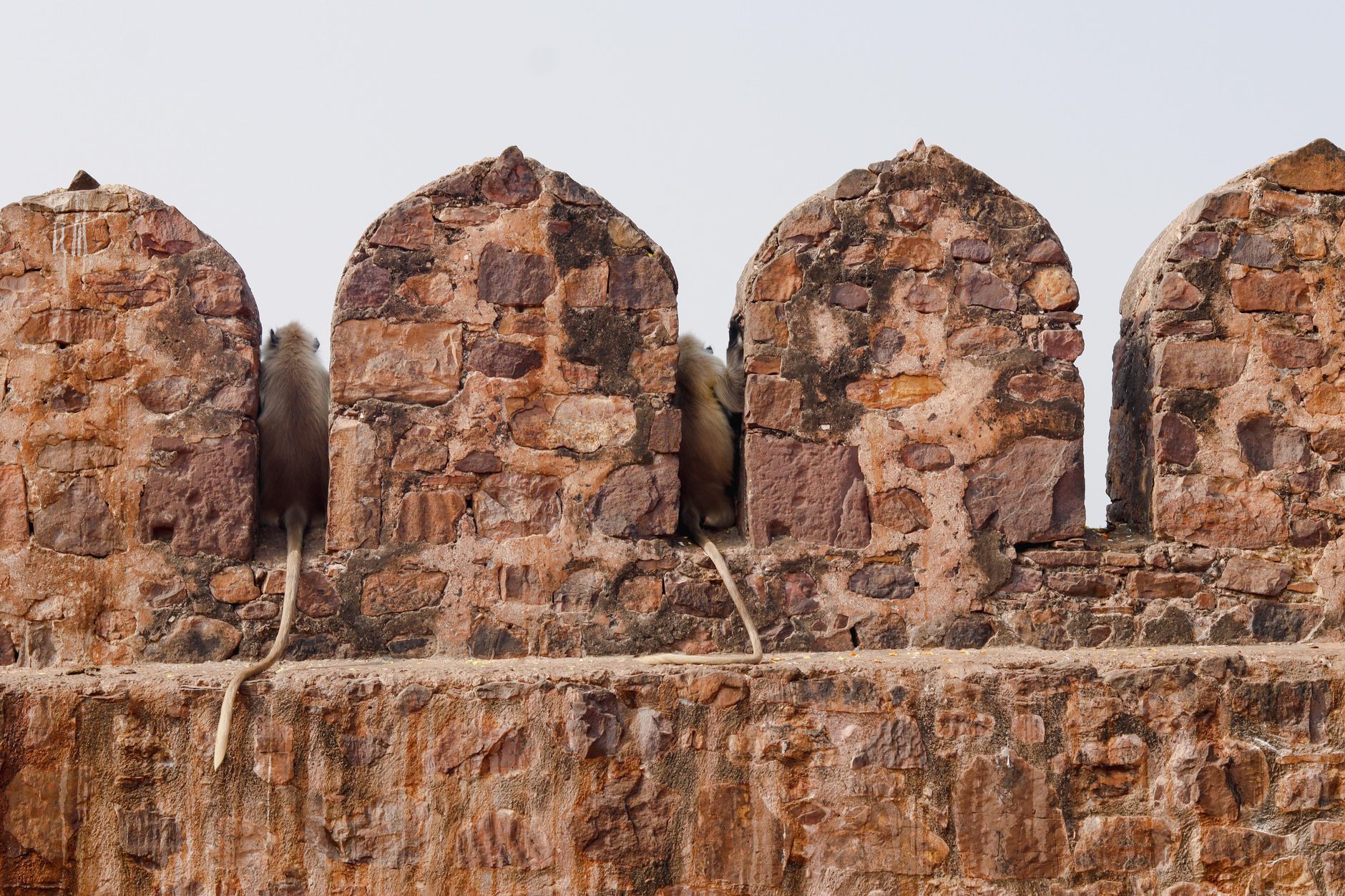
Ghiyas-ud-din Tughlaq founded Tughlaqabad in 1321 as the third city of Delhi and had it walled within about five years. The circuit runs roughly 6.5 km with thirteen gates and bastions up to 30 metres high, built in a distinctive battered, sloping style from massive undressed stone quarried on the spot. The fort was largely abandoned after Ghiyas-ud-din's death in 1325, and popular tradition attributes this to the curse of the Sufi saint Nizamuddin Auliya, whose workmen the sultan had conscripted: ya rahe ujjar, ya base Gujjar — either it stays desolate, or the herdsmen live here. Across the road, linked by a stone causeway over what was once a reservoir, stands the sultan's own tomb, a compact red sandstone and marble structure inside a pentagonal bastioned enclosure. A short distance southeast lies the smaller fort of Adilabad, built by his successor.
Visiting is closer to a hike than a monument tour. From the ticket gate you climb onto the ramparts and walk; there is no signed route, no restored palace and no interpretation beyond a few ASI boards. What you get is scale — bastions you can walk inside, vaulted underground chambers, stepped water tanks, and long views over the Aravalli scrub towards the Badarpur road. Goats graze on the walls and the ruins are genuinely overgrown in places. The most rewarding hour is the southern rampart line, where the wall is best preserved and you can see the internal city grid as low humps under grass. Then cross the causeway to Ghiyas-ud-din's tomb, which is the opposite in character: tidy, enclosed, its marble dome and sloping sandstone walls in excellent condition, and reached through a steep arched gate.
Plan two to three hours and treat it as an outdoor expedition. Wear proper shoes — the stone is loose and there are unfenced drops. Take at least a litre of water per person; there is nothing to buy inside and only occasional vendors at the gate. Go with company rather than alone, especially away from the main path, and finish well before dusk. A hat and sunscreen are not optional. Do not expect a guide at the gate; if you want interpretation, download a map or read up beforehand. Skip Adilabad unless you have a full morning and a real appetite for ruins, as it involves crossing rough ground with no formal path.
The Violet Line's Tughlakabad station is the practical approach, about 2.5 km from the fort gate: from Rajiv Chowk allow 35-40 minutes and about ₹40, then an auto for ₹50-80. Do not confuse Tughlakabad metro with Tughlakabad railway station, which is further away. Coming from Saket, an app cab takes 15-20 minutes and costs ₹150-250. The gate is on Mehrauli-Badarpur Road, well signed, with an unpaved ASI parking area for around ₹20-30. Buses running the Mehrauli-Badarpur corridor stop close to the gate. From Aerocity a cab is 35-45 minutes via the Ring Road. The tomb enclosure has its own gate on the far side of the road, reached by the causeway, so leaving the fort by the wrong exit adds a long detour.
Entry is ₹25 for Indian nationals and SAARC and BIMSTEC citizens and ₹300 for other foreign nationals, with a small online discount on the ASI portal. Under-15s go free. The same ticket admits you to Ghiyas-ud-din Tughlaq's tomb across the causeway, so keep the stub and do not pay twice. A video camera permit is ₹25. Parking is extra and cash only. There are no cafés, no shops and no toilets worth relying on inside the fort, so budget for water and snacks bought before you arrive. Autos from the metro are not metered in practice; agree ₹50-80 each way in advance, or use an app, and expect to pay a return premium because few drivers wait at the gate.
Early morning is best in every sense: cooler, safer underfoot, better light on the sloping ramparts and more chance of company on the walls. Arrive at 07:00-08:00 in summer, 08:00-09:00 in winter. Weekdays it can be almost deserted, which is the appeal and also the caution. Sundays bring local families to the tomb enclosure but the ramparts stay quiet. The fort opens every day. November to February is the right season, with clear air and comfortable walking; December fog can strip the long views entirely until mid-morning. April to June is dangerous heat on unshaded stone, regularly over 43°C. The monsoon makes the rubble slick and the undergrowth thick with snakes and thorn scrub, and is best avoided.
This is a site for confident walkers, ruin enthusiasts and photographers. It is not suitable for wheelchair users at all — there are no made paths, only rubble slopes and steps — and it is a poor choice with toddlers or anyone unsteady. Older children who enjoy scrambling will love it. It is useless in the rain and unwise in the dark. For a one-hour gap it does not work: the transfer from the metro alone eats forty minutes return. Solo travellers, especially women, should stick to the visible main areas and the tomb enclosure, and go in the morning; this is the least staffed of Delhi's major monuments and coverage away from the gate is thin.
Nearby, the tomb of Ghiyas-ud-din is the obvious pairing, ten minutes on foot across the causeway. Qutub Minar and Mehrauli Archaeological Park are 8 km west, a ₹200-300 cab, and make a strong archaeological day if you start here at opening. Saket, 6 km northwest, has the nearest reliable lunch and air conditioning. Honest caveats: there is no restored interior, no museum and very little signage, so visitors expecting a Red Fort experience leave disappointed; sections of the wall are unsafe and unfenced; monkeys are numerous and will take food from your hand; and the site is genuinely isolated, so the standard advice about going in daylight and in pairs is real advice, not boilerplate.
Hours & entry
Not free
Daily 07:00-17:00 · Ticket counter closes 16:30 · Ghiyasuddin Tughlaq's tomb across the causeway keeps the same hours
What to see
{'what': 'Tomb of Ghiyas-ud-din Tughlaq', 'where': 'Pentagonal enclosure across the causeway, south of the fort gate'}
{'what': 'Southern rampart walk', 'where': 'Follow the wall right from the main gate for about 800 m'}
{'what': 'Underground vaulted chambers', 'where': "Beneath the citadel mound in the fort's southwest corner"}
Tips from the ground
Keep your ticket stub — the same one admits you to Ghiyasuddin's tomb across the road.
Agree the auto fare from Tughlakabad metro both ways; almost no drivers wait at the gate.
Go in the morning, in shoes with grip, and not alone on the far ramparts.
Questions, answered
How much does Tughlaqabad Fort cost?
₹25 for Indian nationals and SAARC and BIMSTEC citizens, ₹300 for other foreign nationals, with a small discount for booking on the ASI e-ticketing portal. Children under 15 are free. Crucially, the same ticket covers Ghiyas-ud-din Tughlaq's tomb across the causeway, so hold on to the stub. Video camera permits are ₹25 and parking is roughly ₹20-30 cash. There is nothing to buy inside, so bring your own water.
Are there free entry hours?
No. Tughlaqabad charges the same rate all day, every day, with no free window and no discounted evening. Under-15s are the only routine exemption. Because the site is huge and lightly staffed, people sometimes assume the outlying ramparts are free to wander — they are within the ticketed monument, and ASI staff do check. Budget the ₹25 or ₹300, and remember it also gets you into the tomb enclosure opposite.
How long should I allow?
Two to three hours. An hour gets you the main gate, the citadel mound and a stretch of the southern rampart. Two hours adds the underground chambers and a proper walk along the wall. Three hours lets you cross the causeway to Ghiyas-ud-din's tomb without rushing. Add 40 minutes return for the auto transfer from Tughlakabad metro, and start early: this is hot, exposed walking with no shade.
Is it closed on any day?
No, it opens seven days a week from 07:00 to 17:00, Mondays included, with the ticket counter closing about 16:30. Guards begin clearing the ramparts before closing time and you should not still be on the far walls at dusk. There is no seasonal closure, but sections can be roped off after heavy monsoon rain when the rubble becomes unstable, and the undergrowth is left uncut in July and August.
Do I need to book in advance?
Not at all. Tughlaqabad is one of the least visited major monuments in Delhi and there is essentially never a queue at the counter. An ASI e-ticket is convenient and marginally cheaper, but walking up works fine any day of the week. What is worth arranging ahead is transport: few autos wait at the gate for the return trip, so either keep a driver's number or book an app cab before you finish walking.
Which metro station is closest?
Tughlakabad on the Violet Line, about 2.5 km from the gate; from Rajiv Chowk allow 35-40 minutes and around ₹40, then a ₹50-80 auto. Do not confuse it with Tughlakabad railway station, which is much further. From Saket an app cab takes 15-20 minutes for ₹150-250. Buses along Mehrauli-Badarpur Road stop near the entrance, and there is a rough ASI car park charging about ₹20-30.
Doing good is the business: every booking through Stay New Delhi funds one verified tonne of carbon removal — same room, same price, no markup.
Start Your Search